
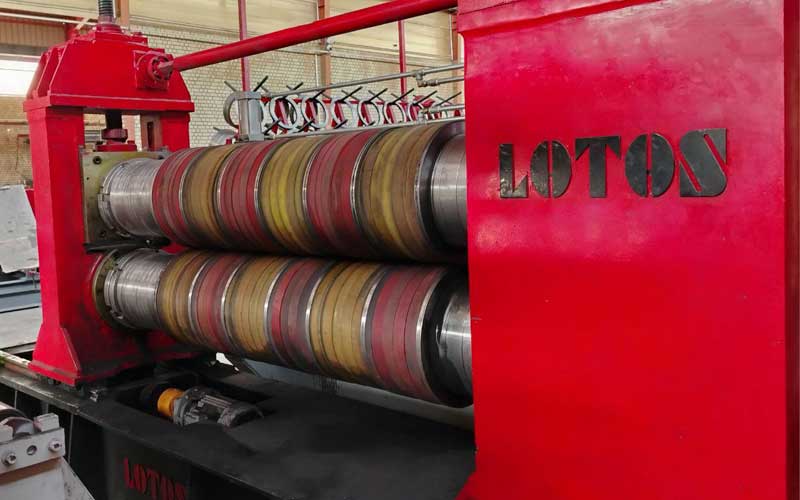
Industrial Cutting & Slitting Units
Slitting equipment is a critical component in modern metal processing lines, designed to cut wide metal coils into narrower strips with high precision and consistency. This equipment is widely used in industries such as roll forming, tube and pipe manufacturing, automotive production, and steel service centers, where dimensional accuracy and edge quality are essential.
What Is Slitting Equipment?
Slitting equipment refers to an integrated mechanical system that unwinds a master coil, slits it longitudinally into multiple narrower coils, and recoils the finished strips. The process is continuous and engineered to handle high speeds, tight tolerances, and a wide range of materials, including carbon steel, stainless steel, aluminum, and galvanized steel.
Main Components of Slitting Equipment
A typical slitting line consists of several key sections, each designed to ensure stable operation and high-quality output:
Uncoiler
Supports and unwinds the master coil while maintaining proper tension control.Peeler Table and Entry Guide
Guides the strip into the line and ensures accurate alignment before slitting.Slitting Head (Arbor System)
The core of the equipment, equipped with precision slitting knives mounted on arbors to achieve exact strip widths and clean edges.Scrap Winder
Collects edge trim generated during the slitting process.Tension Unit
Maintains uniform strip tension to prevent camber, waviness, or surface defects.Recoiler
Rewinds the slit strips into tight, well aligned coils suitable for downstream processing.
Technical Performance Characteristics
High quality slitting equipment is engineered to meet strict technical requirements, including:
High slitting accuracy and repeatability
Stable operation at high line speeds
Minimal burr formation and excellent edge quality
Fast knife change and setup time
Compatibility with different coil widths, thicknesses, and materials
Advanced systems may also include automated knife positioning, hydraulic expansion arbors, and digital control interfaces to improve efficiency and reduce operator dependency.
Importance of Precision in Slitting Equipment
Precision is a defining factor in slitting operations. Inaccurate slitting can lead to downstream problems such as roll forming instability, poor welding quality in tube mills, or excessive material waste. Properly engineered slitting equipment ensures consistent strip width, parallel edges, and uniform coil tension, all of which are essential for high speed and automated production lines.
Applications of Slitting Equipment
Slitting equipment is commonly used in:
Roll forming lines for profiles and structural sections
Automotive and appliance manufacturing
Steel service centers and coil processing facilities
Its role is fundamental in preparing raw material for further forming, welding, or stamping processes.
Conclusion
Slitting equipment is a vital investment for any industrial operation involved in coil processing. A well designed slitting line enhances productivity, improves product quality, and reduces material waste. For manufacturers seeking reliable and high performance slitting solutions, selecting equipment engineered to international standards is essential for long term operational success.
