
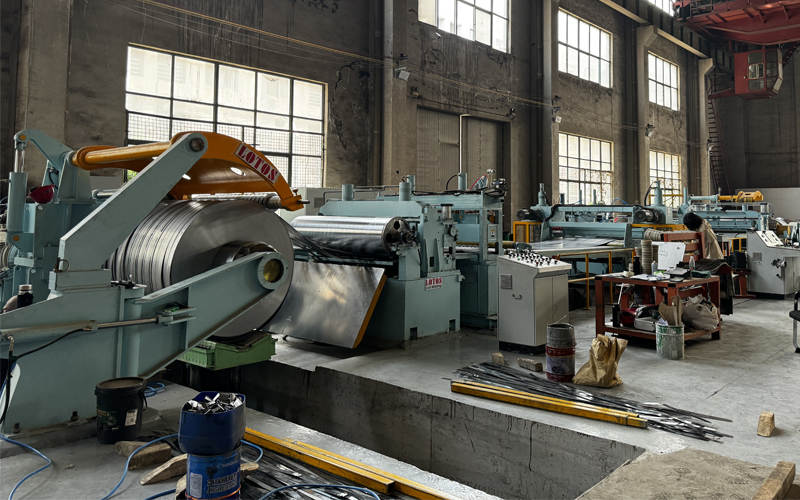
What Is a Slitting System?
In the world of metal processing, the slitting system is the heart of any coil slitting line. It is the critical assembly responsible for transforming wide master coils into precision-engineered narrow strips that feed downstream industries like automotive, construction, and appliance manufacturing. For operators and plant managers, understanding the mechanical intricacies and technological advancements of these systems is key to maximizing throughput, ensuring edge quality, and minimizing downtime.
This technical guide provides a comprehensive overview of modern slitting systems, with a focus on the engineering principles that define high performance metal slitting lines.
1. What is a Slitting System? Defining the Core Process
A slitting system is a specialized assembly of mechanical and electrical components designed to shear large coils of material such as steel, aluminum, or stainless steel into multiple narrower coils . While the term “slitting” is used across various industries for materials like paper or plastic, metal slitting is a distinct discipline governed by metallurgy and high-tensile forces .
The primary objectives of a precision slitting system are:
Dimensional Accuracy: Achieving tight width tolerances (often within ±0.05mm) consistently across the entire coil length .
Edge Quality: Producing clean, burr free edges to eliminate the need for secondary de-burring operations .
Operational Efficiency: Minimizing setup time between production runs (changeovers) and maintaining high line speeds.
2. Core Components of a Precision Slitting Line
A complete slitting line is a synchronous system, but the slitting system itself relies on the performance of peripheral modules to ensure a stable cut. Based on the engineering of heavy-duty lines, the key components work in concert :
Unwinder (Decoiler): Holds the master coil and feeds the material into the line. In heavy gauge applications, hydraulic mandrels with press arms are used to handle coils up to 35 tons, ensuring the strip is straightened and fed correctly into the accumulator .
Looper (Pit or Car-Type): This acts as a buffer between the continuous operation of the slitter and the intermittent operation of the uncoiler. By storing material, it allows the line to run continuously while the entry section slows down to weld or feed a new coil, significantly improving overall efficiency .
Slitter (The Heart of the System): This is where the cutting happens. It consists of two parallel arbors (shafts) holding multiple rotary knives and spacers. The precision of these arbors their hardness, diameter (e.g., φ240mm), and resistance to deflection directly dictates cut quality . Modern systems use motorized positioning for the movable housing to allow for quick knife engagement and disengagement .
Tensioning Device (Bridle): After slitting, each strip must be rewound under controlled tension. A tension stand creates back-pressure, ensuring the recoiled strips are tight, telescope-free, and have consistent density .
Recoiler: Rewinds the slit strips onto individual cores. Modern recoilers feature hydraulic, segmented mandrels (e.g., 8-fan-shaped plates) that expand to grip the inner diameter of the coil securely and include a “clip mouth” to grab the strip head for automatic starting .
3. The Mechanics of Metal Slitting: Shear vs. Crush
In metal slitting, the method of cut is paramount. While flexible materials may use razor blades, metal processing relies on two primary methods: Shear Slitting and Crush Cutting .
Shear Slitting (The Gold Standard for Metals)
Shear slitting mimics the action of a pair of scissors. It utilizes a male (top) knife and a female (bottom) knife that overlap slightly as the material passes between them .
Technical Parameters: For reliable operation, factors like cant angle (typically 0.5°), overlap (often starting at 0.7mm), and side force must be precisely controlled .
Advantages: This method provides the cleanest edge finish, highest precision, and longest blade life. It is suitable for a wide range of materials, from thin-gauge tinplate to grain-oriented electrical steels .
Application: Ideal for high-volume production where edge quality is critical for downstream forming or stamping.
Crush Cutting (Score Slitting)
This method uses a single top knife pressed with significant force against a hardened anvil roll (or bottom knife), literally crushing the material to separate it .
Technical Parameters: Requires precise control of blade penetration depth and air pressure to prevent the blade from slamming into the anvil, which can cause immediate chipping . The anvil roll must be harder (e.g., 63-65 Rc) than the knife (60-62.5 Rc) .
Advantages: Lower initial tooling cost and simpler setup.
Limitations: Generates more dust and burrs, and blade life is significantly shorter than shear slitting . Often used for thicker, non-critical materials or where the edge will be further processed.
4. Advanced Features in Modern Slitting Systems
To meet the demands of Industry 4.0, modern slitting systems have evolved beyond simple mechanical assemblies.
4.1 Automation and Tooling Positioning
Manual setup of knives and spacers is a major source of downtime. High end systems now feature CNC controlled knife positioning. Operators can recall a production recipe from the PLC, and the system automatically repositions the knife holders on the arbors. As noted in advanced converting systems, automated positioning can reposition multiple knives in under a minute with precision tolerances, drastically reducing changeover time and operator error .
4.2 Closed Loop Tension Control
Inconsistent tension is the enemy of quality slitting. Modern lines use feedback-controlled tension systems. Sensors monitor the dancer roll position or direct tension, sending real time data to the PLC, which adjusts the recoiler drive or brake pressure instantaneously. This prevents issues like telescoping (where coils slide sideways) and cross coil tension variations .
4.3 Blade Metallurgy and Clearance
Tooling is where precision is won or lost.
Materials: Knives are often made from high-carbon steel (52100), tool steels (D2, M2), or carbide for extended life .
Clearance: The gap between the knives is not arbitrary. It must be calculated based on the material’s thickness and tensile strength. Too much clearance creates a rough break (burr); too little causes rapid blade wear and excessive heat .
5. Optimizing Performance and Maintenance
To ensure longevity and performance of a slitting system, technical managers must prioritize:
Preventive Maintenance: Regular inspection of arbors for runout (radial and axial) is critical. Even minor deflection (measured in microns) will result in poor cut quality .
Lubrication and Cooling: Especially in shear slitting, lubricating the knife edges reduces friction and heat buildup, preventing material smearing and extending blade life .
Operator Training: A precision machine is only as good as its operator. Understanding the nuances of knife geometry, side force adjustment, and material behavior is essential for safety and quality .
Conclusion
A slitting system is a sophisticated integration of mechanics, hydraulics, and software. For manufacturers processing heavy gauge metals, investing in a line with robust components such as hardened gearboxes, precision machined arbors, and intelligent PLC control is essential for maintaining a competitive edge. At Lotosslitting, our systems are engineered to deliver the ±0.05mm precision and burr free edges that modern industry demands, ensuring your converting process is both reliable and profitable .
