
A Comprehensive Technical Guide to Steel Coil Processing
In the modern metal processing industry, precision and efficiency are paramount. A slitting line represents one of the most critical pieces of equipment in steel service centers and manufacturing facilities worldwide. At Lotosslitting, we specialize in providing advanced slitting line solutions that meet the demanding requirements of contemporary metal processing operations. This technical article explores the fundamental aspects of slitting lines and the steel slitting process.
What is a Slitting Line?
A slitting line is an industrial machine system designed to cut large master coils of metal into narrower strips of specified widths. This precision coil processing equipment is essential for transforming wide-gauge metal coils into multiple narrower coils that meet specific customer requirements for various manufacturing applications.
Slitting lines are engineered to process various materials, including:
- Cold and hot-rolled steel coils
- Stainless steel
- Aluminum
- Copper and brass
- Galvanized steel
- Electrical steel
The primary function of a slitting line is to unwind a master coil, slit it longitudinally into multiple narrower strips using precision rotary knives, and then rewind these strips into individual coils with consistent tension and edge quality. Modern slitting lines, such as those manufactured by Lotosslitting, incorporate advanced automation and control systems to ensure exceptional accuracy, typically maintaining width tolerances within ±0.1mm.
Steel Slitting Line Process
The steel slitting process is a sophisticated, multi-stage operation that requires precise engineering and control. Understanding each stage is crucial for optimizing production efficiency and product quality.
1. Coil Loading and Pay Off
The process begins with loading the master coil onto an uncoiler or pay off reel. This component must accommodate varying coil weights, typically ranging from 5 to 40 tons, depending on the line’s capacity. Modern slitting lines feature hydraulic or mechanical expanding mandrels that securely grip the coil’s inner diameter while allowing for quick changeovers between different coil sizes.
Key considerations at this stage include:
- Proper coil alignment to prevent tracking issues
- Controlled uncoiling tension to prevent material damage
- Edge guidance systems to maintain coil positioning
2. Coil Flattening and Leveling
Before the material enters the slitting section, it passes through a leveling or flattening machine. This critical stage removes coil set, crossbow, and other shape defects that may have developed during the steel production or previous processing operations. The leveler consists of a series of work rolls that bend the material alternately in opposite directions, effectively eliminating internal stresses and ensuring flat, uniform material enters the slitting heads.
3. Edge Guiding and Feeding
An edge guiding system (EGU) monitors and corrects the lateral position of the strip as it feeds into the slitter. This system uses sensors to detect edge position and makes real time adjustments to ensure precise alignment with the slitting knives. Proper edge guidance is essential for maintaining consistent strip widths and preventing edge damage during the slitting operation.
4. The Slitting Process
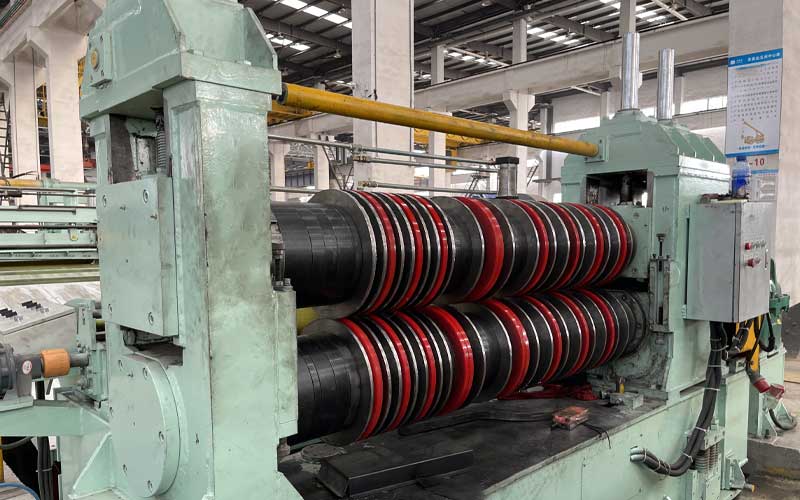
The heart of the slitting line is the slitter head, which houses the rotary cutting knives. The slitting process employs one of two primary methods:
Razor Slitting: Used primarily for thinner, softer materials such as aluminum foil and thin gauge steel. This method uses a single knife that penetrates the material against a hardened anvil roll.
Rotary Shear Slitting: The most common method for steel processing, utilizing matched upper and lower knives that create a scissor-like cutting action. The knives are precisely spaced according to the desired strip widths and feature specific clearances and overlaps optimized for the material thickness and type.
At Lotosslitting, our slitter heads are engineered with:
- Hig precision knife holders with micrometer adjustments
- Quick-change knife systems for reduced setup times
- Rigid housings to minimize deflection during cutting
- Advanced lubrication systems to extend knife life
5. Strip Separation and Guidance
After slitting, the multiple strips must be separated and guided to prevent interlocking or scratching. Strip separators, often made of specialized plastics or composites, maintain proper spacing between strips as they travel toward the rewind section. This stage is critical for maintaining edge quality and preventing surface damage.
6. Tension Control and Rewinding
The final stage involves rewinding the slit strips into individual coils with controlled tension. Modern slitting lines employ sophisticated tension control systems, which may include:
- Differential rewinding: Allows each strand to be wound with independent tension control
- Surface winders: Use contact pressure against the coil surface to control tension
- Center winders: Apply torque directly to the rewind mandrel
Proper tension control is essential for producing tight, uniform coils that maintain their shape during handling and transportation. The rewind section must accommodate varying strip widths and thicknesses while maintaining consistent coil quality.
7. Coil Unloading and Packaging
Once the rewinding process is complete, the finished coils are unloaded using coil cars, conveyors, or overhead cranes. The coils are then banded, labeled, and prepared for shipment or further processing.
Key Components of a Modern Slitting Line
A complete slitting line system integrates numerous sophisticated components:
- Entry Equipment: Coil cars, upenders, pay-off reels, and peeler/breakaway rolls
- Processing Section: Levelers, edge guides, feed rolls, and the slitter head
- Exit Equipment: Strip separators, tension stands, rewinders, and coil handling systems
- Control Systems: PLC-based automation, HMI interfaces, and quality monitoring systems
- Hydraulic and Pneumatic Systems: For actuation, clamping, and tension control
- Electrical Systems: Variable frequency drives, motors, and power distribution
Applications of Slit Steel Coils
Slit steel coils serve diverse industries and applications, including:
- Automotive manufacturing: Body panels, structural components, and trim
- Construction: Roofing, siding, and structural framing
- Appliance production: Housings, brackets, and internal components
- Tube and pipe mills: Feedstock for welded tube production
- Stamping and forming operations: Blanks for pressed components
- Electrical industry: Transformer cores and motor laminations
Conclusion
Steel slitting lines represent a critical link in the metal processing supply chain, transforming master coils into precision-width strips that meet exacting industrial specifications. The slitting process demands sophisticated engineering, precise knife technology, and advanced control systems to ensure optimal productivity and product quality.
At Lotosslitting, we are committed to delivering state of the art slitting line solutions that combine precision engineering with operational efficiency. Our systems are designed to handle the most demanding processing requirements while minimizing waste, reducing setup times, and maximizing throughput.
