
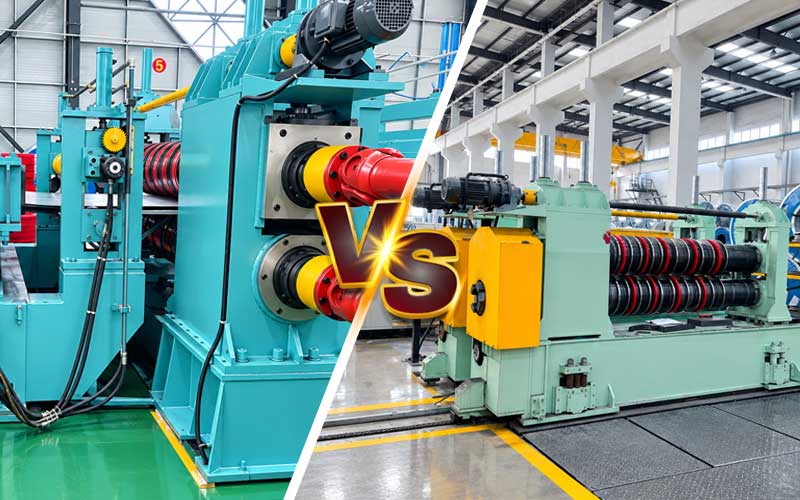
Single Blade vs Double Blade Slitting Machine
Slitting lines are essential equipment in the metal processing industry, converting master coils of steel, aluminum, or other metal substrates into narrower strips of precise width and tension. At the core of every slitting line lies the slitter head. The mechanism responsible for the actual cutting operation. Manufacturers and processors evaluating a new slitting line investment must decide between a single slitter head configuration and a double slitter head configuration. This decision has significant implications for production capacity, product flexibility, floor space requirements, and capital cost. This article examines the technical distinctions between the two configurations to help metal processors make an informed equipment decision.
What Is a Slitter Head?
The slitter head is the assembly of upper and lower circular knives (blades) mounted on arbors that shear a wide metal coil into multiple narrower strips as it passes through the line. The slitter head’s design determines the number of simultaneous cuts, the precision of the slit edges, the range of achievable strip widths, and the overall throughput of the line. Slitter heads may be configured as rotary shear type or razor type (score-slitting), depending on material thickness and application, but the focus of this comparison is on the number of heads employed: single versus double.
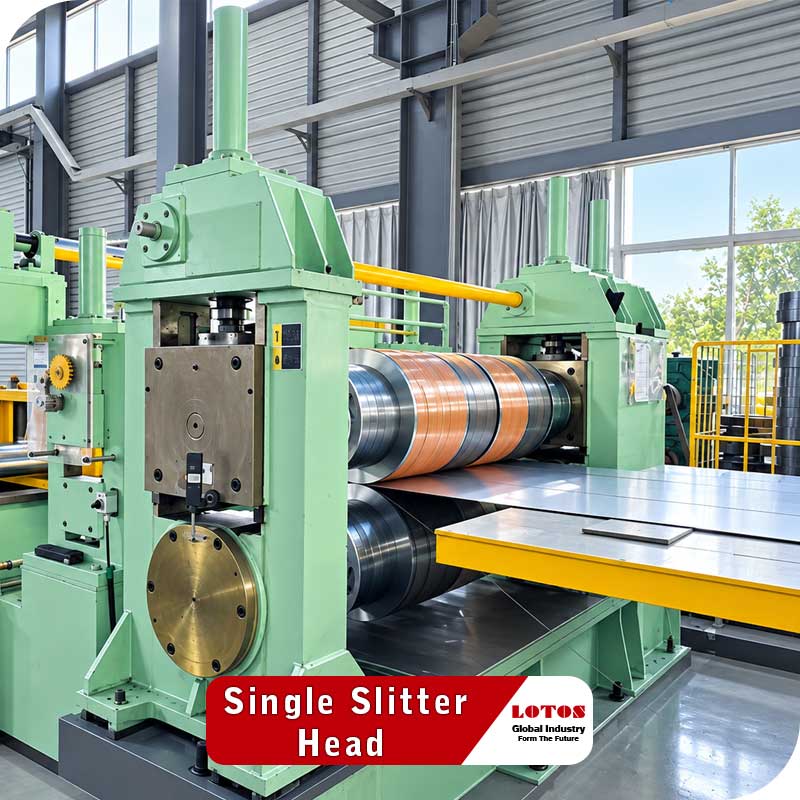
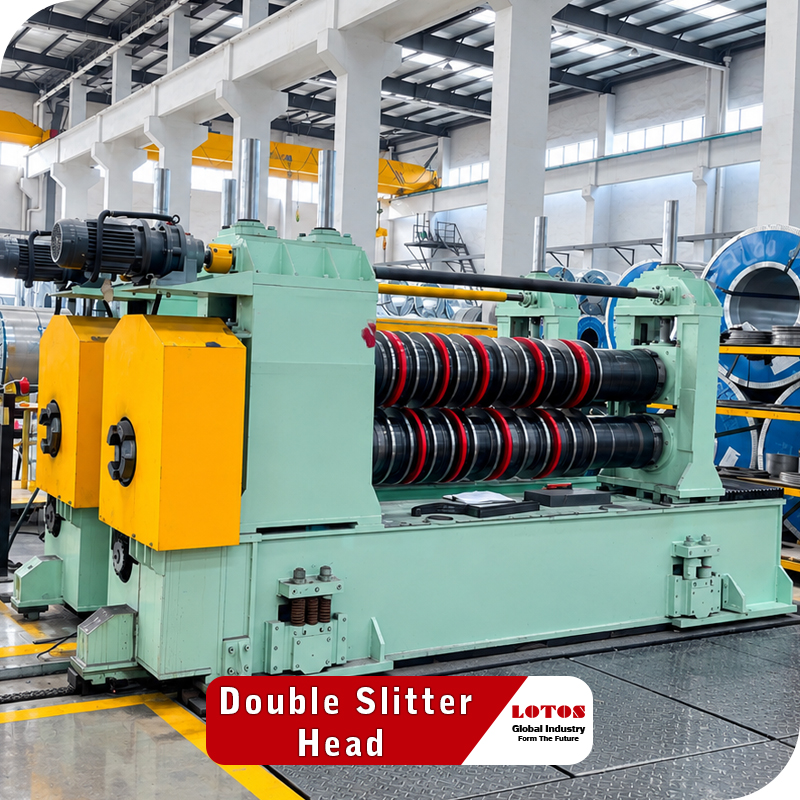
Slitter head Slitting Line
A single slitter head line uses one set of upper and lower knife arbors to perform all slitting operations on a coil in a single pass.
Technical Characteristics
- Single cutting station: All strip widths for a given coil are produced from one arbor set, requiring a full knife changeover or spacer adjustment when switching to a different slitting pattern.
- Simpler mechanical structure: Fewer components reduce the complexity of the drive train, hydraulic system, and control architecture.
- Lower capital investment: With fewer precision components (arbors, bearings, spacers, and knives), single-head lines typically carry a lower upfront equipment cost.
- Smaller footprint: A single-head line generally requires less floor space, making it suitable for facilities with spatial constraints.
- Setup time per job: Because only one cutting station exists, changing slitting patterns (width combinations) requires halting production to reconfigure the arbor, which can reduce line utilization when running many short-run orders.
Typical Applications
Single slitter head lines are well suited to operations with high-volume, repetitive slitting patterns, moderate product mix, and facilities where capital efficiency and simplicity of maintenance are prioritized over maximum flexibility.
Double Slitter Head Configuration
A double slitter head line incorporates two independent cutting stations within the same line, typically arranged in tandem along the line’s pass line.
Technical Characteristics
- Dual cutting stations: Two arbor sets allow two different slitting patterns to be pre-set simultaneously. While one head is in production, the second can be prepared offline for the next job, or both heads can be used in sequence for multi-stage slitting of heavier or wider coils.
- Reduced changeover downtime: Because a second head can be pre-loaded with knives and spacers while the first is running, the line can switch between patterns far more quickly, improving overall equipment effectiveness (OEE).
- Higher throughput potential: For processors handling frequent width changes or diverse order books, the ability to alternate between two pre-configured heads significantly increases productive slitting time.
- Greater mechanical and control complexity: Two heads require additional drive motors, tension control zones, hydraulic clamping systems, and more sophisticated PLC/HMI coordination to synchronize both stations with the uncoiler, tensioning devices, and recoiler.
- Larger footprint and higher capital cost: The additional cutting station, along with associated guiding and tension equipment, increases both the physical length of the line and the initial investment.
- Enhanced tolerance for heavier gauges: In some double-head designs, the two stations can be used together, one performing a coarse cut and the second a finishing cut, improving edge quality on thicker or higher-strength materials.
Typical Applications
Double slitter head lines are advantageous for service centers and processors serving diverse customer specifications, those running frequent, small batch orders with varying width requirements, and operations where minimizing changeover time directly translates into higher revenue per shift.
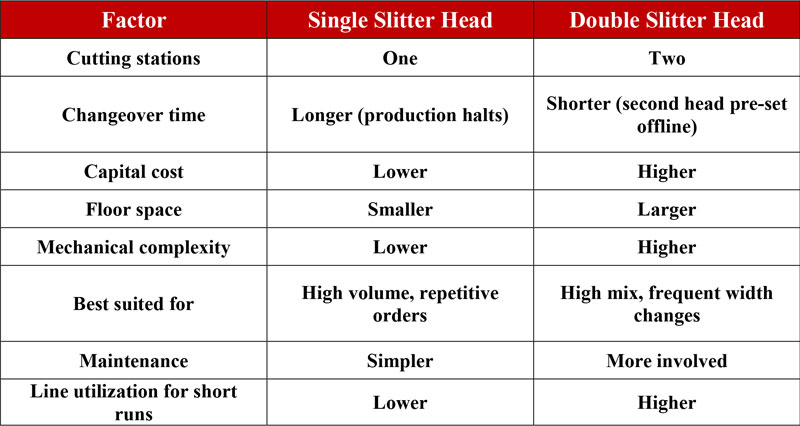
Comparative Summary
Key Selection Criteria
When choosing between a single and double slitter head slitting line, processors should evaluate the following factors:
- Order profile: A high proportion of small-batch, custom-width orders favors a double-head line, as the reduction in changeover downtime compounds significantly over time.
- Material range: Facilities processing a wide range of gauges and tensile strengths may benefit from the added flexibility of a double-head configuration, particularly where two-stage cutting improves edge quality.
- Available floor space: Facilities with limited plant length may be constrained to a single-head design regardless of production preferences.
- Capital budget and ROI horizon: The additional cost of a double-head line must be justified by the throughput and changeover gains it delivers; a return-on-investment analysis based on expected order mix is recommended.
- Operator training and maintenance capacity: Double-head lines demand a higher level of technical proficiency from operators and maintenance staff due to the added control systems and mechanical components.
Conclusion
Both single and double slitter head slitting lines serve important roles in metal coil processing, and neither configuration is universally superior. The single slitter head design offers simplicity, a smaller footprint, and lower capital cost, making it ideal for processors with stable, high-volume production runs. The double slitter head design, by contrast, delivers superior flexibility and reduced changeover time, making it the preferred choice for processors managing diverse, high-mix order books. A careful assessment of production volume, order variability, available space, and budget will guide processors toward the configuration that best aligns with their operational goals. For tailored guidance on selecting the optimal slitting line configuration for a specific application, consulting with an experienced slitting line manufacturer such as Lotos Slitting can help ensure the equipment investment matches long-term production requirements.
FAQ:
Yes. The added drive systems, hydraulic components, and PLC/HMI coordination between two cutting stations demand a higher level of technical proficiency from operators and maintenance personnel compared to a single-head line.
Double slitter head lines offer faster changeover. Because the second head can be loaded with knives and spacers offline while the first head continues production, the line can switch to a new width pattern with minimal interruption, compared to a single-head line where production must stop for reconfiguration.
Yes. Double slitter head lines require additional arbors, drive motors, tensioning zones, and control system complexity, resulting in higher capital cost and a larger equipment footprint compared to single slitter head lines.
A single slitter head line has one cutting station, meaning all knife setups must be changed on the same arbor before switching to a new slitting pattern. A double slitter head line has two independent cutting stations, allowing one head to run in production while the second is pre-set for the next job, significantly reducing changeover downtime.
