Slitting Line Machine And Tube Mill Machine
A steel slitting machine for tube mill is a precision coil-processing system used to convert wide steel coils into narrow strips suitable for tube and pipe production. In a modern tube mill, the quality of the slit strip directly affects forming stability, welding performance, dimensional accuracy, and overall production efficiency.
For tube and pipe manufacturers, selecting the correct steel slitting line is therefore an important part of designing an efficient raw-material preparation system. A properly engineered slitting line can provide accurate strip widths, clean edges, stable coil tension, and consistent strip quality for downstream tube mill production.
What Is a Steel Slitting Machine for Tube Mill?
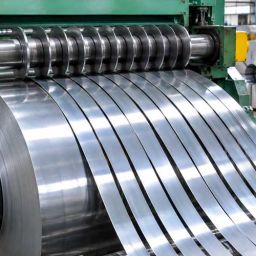
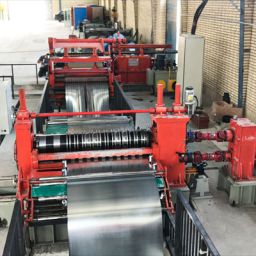
A steel slitting machine for tube mill continuously processes a master steel coil by cutting it longitudinally into multiple narrower coils, commonly called slit coils or mults.
The basic process is:
Master Coil → Uncoiling → Leveling → Slitting → Tensioning → Recoiling → Slit Coils
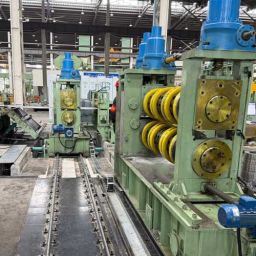
The resulting narrow strips can then be supplied to an ERW tube mill, where they are formed into round, square, rectangular, or other welded tube profiles.
A tube mill slitting line must be designed around the requirements of the downstream tube mill, including:
- Tube diameter range
- Required strip width
- Steel thickness
- Material grade
- Coil weight
- Slitting width
- Number of strips
- Production speed
- Required edge quality
Why Is Slitting Important for Tube Mill Production?
Tube mills require steel strips with highly consistent dimensions. If the strip width or edge condition varies significantly, problems can occur during forming and welding.
A properly configured slitting machine for tube mill production helps provide:
- Accurate strip width
- Consistent edge quality
- Stable coil tension
- Improved material utilization
- Reduced edge deformation
- Better tube forming stability
- More consistent HF welding conditions
The slitting process is particularly important for ERW tube mills because the slit edges eventually become the edges that are brought together during the high-frequency welding process.
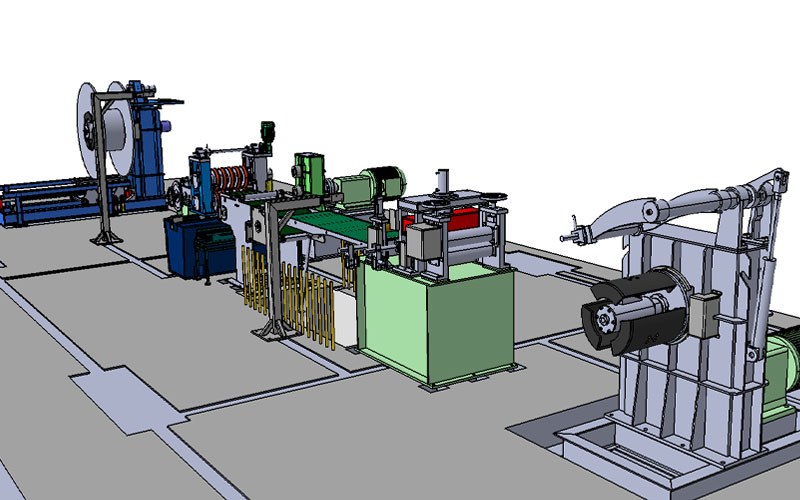
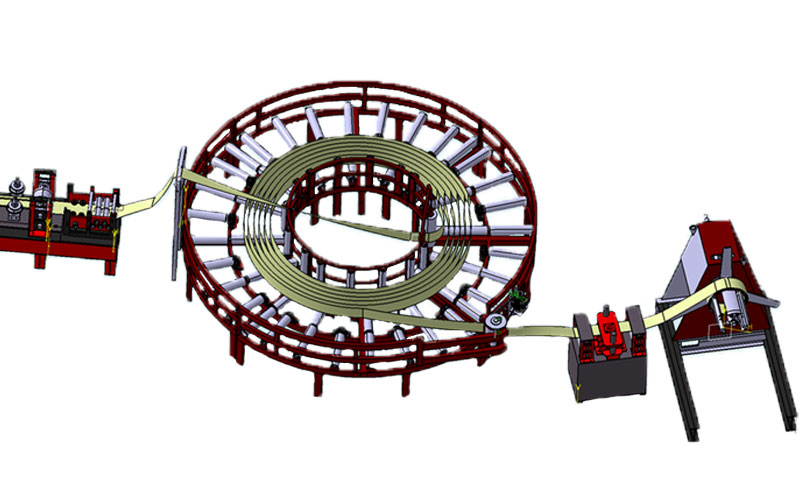
Steel Slitting Process for Tube Mill
1. Coil Loading
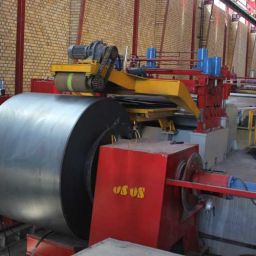
The master coil is transported to the slitting line using a coil handling system. Depending on coil weight and line configuration, a coil car or loading device positions the coil at the entry of the uncoiler.
Correct coil alignment is essential for maintaining stable strip tracking throughout the slitting process.
2. Uncoiling
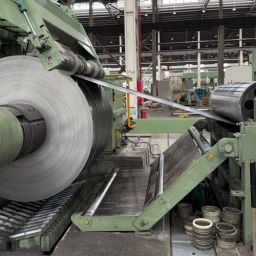
The decoiler, also known as an uncoiler, holds and unwinds the master coil.
The uncoiler may incorporate:
- Hydraulic expansion
- Motorized rotation
- Pneumatic or hydraulic braking
- Coil centering
- Automatic tension control
The purpose is to provide a controlled and continuous supply of steel strip to the slitting section.
3. Strip Leveling
Before slitting, the steel strip may pass through a leveling or flattening section.
Leveling helps reduce:
- Coil set
- Edge wave
- Center buckle
- Strip deformation
A flat and stable strip is important for achieving accurate slitting and consistent downstream coil winding.
4. Slitting
The central operation of the machine is longitudinal cutting.
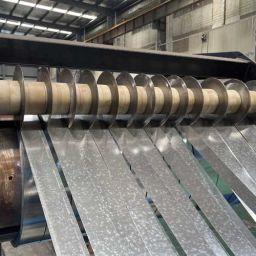
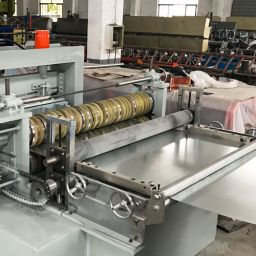
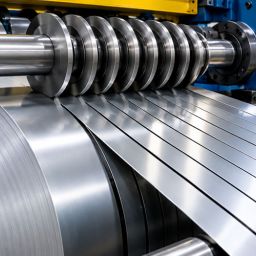
The steel strip passes through a set of circular slitter knives mounted on upper and lower shafts. The knives cut the master coil into multiple narrower strips according to the required widths.
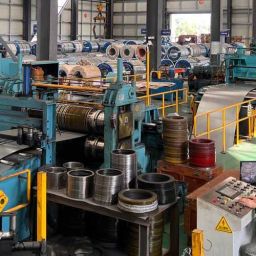
The slitting tooling normally consists of:
- Slitter knives
- Spacers
- Rubber separators
- Knife locking components
- Upper and lower slitter shafts
The tooling arrangement determines the width of each slit strip.
Slitter Knives and Tooling
Slitter knives are critical components of a steel slitting machine. Their material, hardness, geometry, and sharpening condition have a direct influence on edge quality and tool life.
For steel coil processing, slitter knives may be manufactured from high-quality tool steels or carbide-based materials depending on the application.
Important tooling parameters include:
Knife Diameter
The knife diameter affects cutting performance, shaft configuration, and available cutting capacity.
Knife Thickness
Knife thickness influences the available slitting arrangement and minimum slit width.
Spacer Width
Spacers determine the distance between knives and therefore control the width of the slit strips.
Knife Clearance
Correct clearance between the upper and lower knives is essential. Incorrect clearance can result in:
- Burrs
- Edge deformation
- Excessive knife wear
- Poor strip separation
- Unstable slitting
For tube mill applications, maintaining clean and consistent slit edges is particularly important.
5. Strip Separation
After the master coil has been slit, the individual strips must be separated and guided into their correct positions.
A separator disc or strip guide system keeps the slit strips properly organized and prevents them from overlapping or moving laterally.
The separation system should be adjusted according to:
- Strip width
- Material thickness
- Number of strips
- Material strength
- Production speed
6. Tensioning
Tension control is one of the most important aspects of a modern steel slitting line.
After slitting, individual strips can have different tension levels. A tension station applies controlled tension to stabilize the strips before recoiling.
Proper tension helps prevent:
- Loose winding
- Telescoping
- Coil collapse
- Strip displacement
- Uneven coil edges
For tube mill applications, accurately wound slit coils are essential because the coils must later be loaded into the tube mill without feeding problems.
7. Recoiling
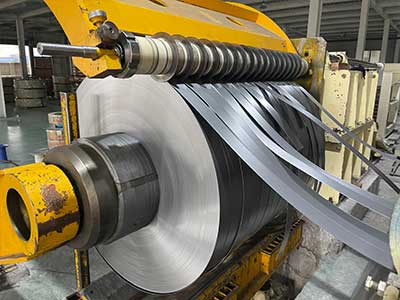
The slit strips are finally rewound into individual coils using a recoiler.
The recoiler must maintain stable winding tension to produce compact and properly aligned slit coils.
A high-quality recoiling system helps produce:
- Tight coils
- Straight coil edges
- Stable coil geometry
- Consistent winding tension
- Easy coil handling
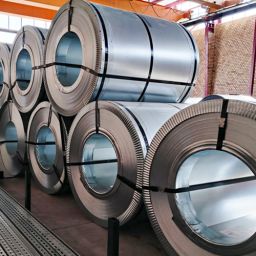
The finished slit coils can then be transferred to storage or directly supplied to the tube mill.
Relationship Between Slitting Width and Tube Mill Size
One of the most important technical considerations is the relationship between slit strip width and finished tube diameter.
The strip width required by a tube mill depends on the finished tube geometry, material thickness, forming method, and production design.
For a simple round tube, the required strip width is related to the tube circumference, but the actual calculation used by a tube mill manufacturer can include adjustments for:
- Material thickness
- Tube diameter
- Forming method
- Weld seam condition
- Sizing requirements
- Roll tooling design
Therefore, the slitting line should normally be designed according to the actual strip-width requirements provided by the tube mill manufacturer.
Steel Thickness for Tube Mill Slitting
A steel slitting machine can be engineered for different material thickness ranges.
Typical considerations include:
- Thin gauge steel
- Medium gauge steel
- Heavy gauge steel
- Stainless steel
- Carbon steel
- Galvanized steel
The machine’s capacity must be matched to the required thickness range. As material thickness increases, the slitting shafts, knives, drive system, tension system, and structural components must be designed to withstand higher cutting and winding forces.
For example, a slitting line designed for 3 mm steel requires a substantially different mechanical configuration from a line designed for very thin strip.
Slitting Speed
The operating speed of a steel slitting machine depends on several factors, including:
- Material thickness
- Material grade
- Coil width
- Coil weight
- Number of slit strips
- Slit width
- Knife configuration
- Required edge quality
- Recoiling requirements
High speed slitting lines require precise synchronization between the uncoiler, slitter, tension station, and recoiler.
For tube mill applications, maximum speed should not be considered independently from strip quality. Stable operation and accurate slit edges are often more important than simply achieving the highest possible line speed.
Steel Slitting Machine Components
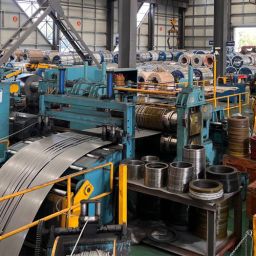
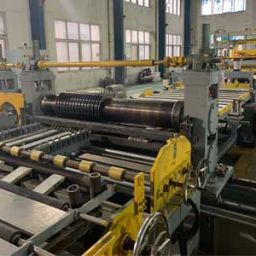
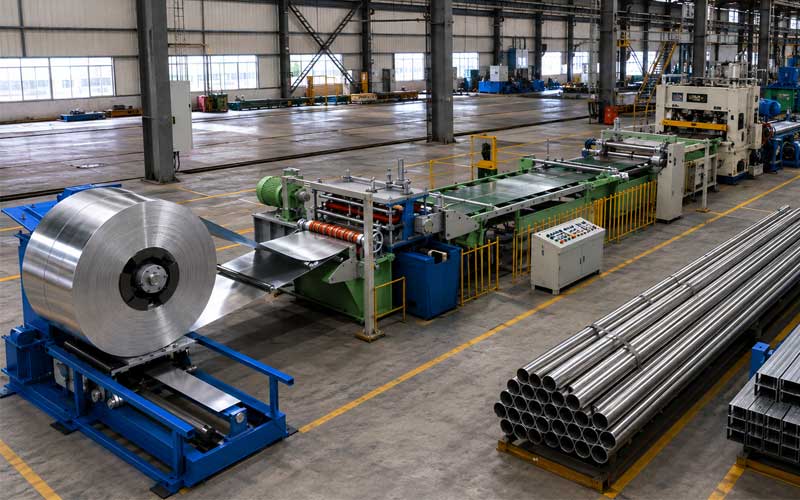
A complete steel slitting machine for tube mill may include the following major components:
- Coil loading car
- Hydraulic decoiler
- Entry guide system
- Leveling machine
- Slitting head
- Slitter knives and spacers
- Scrap edge winder
- Strip separator
- Tension unit
- Recoiler
- Coil discharge system
- Hydraulic system
- Electrical control system
- PLC and HMI
The exact configuration depends on the material and production requirements.
Edge Scrap Handling
During slitting, the outer edges of the master coil may be removed as scrap. A scrap edge winder collects these narrow edge strips continuously.
Efficient scrap handling prevents loose material from interfering with the production line and keeps the slitting area organized.
The scrap winder must be properly synchronized with the main line speed to maintain stable operation.
Quality Requirements for Tube Mill Slit Coils
Slit coils intended for tube production should be inspected before they are transferred to the tube mill.
Important quality parameters include:
Strip Width
The width must remain within the specified tolerance.
Edge Quality
The slit edge should have controlled burr height and minimal deformation.
Coil Tightness
The recoiled strip should have sufficient winding tension to prevent loose layers.
Coil Alignment
The coil edges should remain properly aligned to minimize telescoping.
Surface Condition
The strip should be free from excessive scratches, dents, contamination, or other defects that could affect tube production.
Common Problems in Steel Slitting for Tube Mills
Excessive Burr
Excessive burr can be caused by incorrect knife clearance, worn knives, improper tooling, or unsuitable slitting parameters.
Edge Wave
Edge wave can result from uneven internal stresses in the master coil or incorrect leveling and tension settings.
Telescoping Coil
Telescoping occurs when the slit strips shift sideways during recoiling. Incorrect tension, poor strip alignment, or improper separator adjustment can contribute to this problem.
Loose Coil
Insufficient recoiling tension can produce loose coils that are difficult to handle and may cause feeding problems in the tube mill.
Uneven Slit Width
Incorrect spacer arrangement, knife movement, shaft runout, or improper tooling installation can cause width variations.
How to Choose a Steel Slitting Machine for Tube Mill
When selecting a steel slitting machine for tube mill production, manufacturers should consider the complete production process rather than focusing only on machine speed.
Key factors include:
1. Maximum Coil Width
The machine must accommodate the width of the master coils used by the production facility.
2. Material Thickness
The slitting capacity must cover the complete thickness range required by the tube mill.
3. Material Grade
Carbon steel, stainless steel, galvanized steel, and high-strength materials may require different tooling and machine configurations.
4. Required Slit Width
The minimum and maximum slit widths should correspond to the tube mill’s production range.
5. Coil Weight
The decoiler and recoiler must be capable of handling the maximum coil weight safely.
6. Production Speed
The selected line should provide sufficient speed while maintaining stable slit quality.
7. Automation
PLC control, automatic positioning, tension control, and automated coil handling can improve productivity and reduce operator workload.
Advantages of Using a Dedicated Slitting Line for Tube Mill
A properly engineered slitting line provides several advantages for tube manufacturers.
Improved Raw Material Preparation
The master coil can be divided into the exact strip widths required for tube production.
Better Production Planning
Manufacturers can prepare multiple slit coils from one master coil according to different tube sizes.
Consistent Strip Quality
Precision slitting provides controlled strip dimensions and edge conditions.
Reduced Material Waste
Optimized slitting patterns can improve material utilization and reduce scrap.
Increased Tube Mill Productivity
Properly prepared slit coils can help reduce feeding interruptions and material preparation time.
LOTOSSLITTING Steel Slitting Machine for Tube Mill
LOTOSSLITTING provides customized steel slitting solutions for tube and pipe manufacturers. The slitting line can be engineered according to the required master coil width, material thickness, slit width, coil weight, production speed, and downstream tube mill specifications.
A complete solution can integrate coil loading, decoiling, leveling, precision slitting, scrap edge winding, strip separation, tension control, recoiling, and finished coil handling.
The objective is to provide tube manufacturers with accurately slit steel coils that are suitable for stable and efficient downstream tube mill production.
Conclusion
A steel slitting machine for tube mill is an essential coil-processing system for manufacturers producing welded steel tubes and pipes. By converting wide master coils into accurately slit strips, the machine prepares the raw material for stable forming and high-frequency welding.
The performance of the slitting line depends on the coordination of the slitting knives, spacers, shafts, tension system, decoiler, recoiler, and control system. Proper machine selection and tooling configuration can improve strip quality, reduce production problems, and increase overall tube mill efficiency.
For tube manufacturers, the ideal slitting solution should be designed around the complete production requirements of the tube mill rather than treated as a standalone coil-processing machine.
FAQ:
Precise strip width and clean edges are essential for stable tube forming and high-frequency welding. Accurate slitting can reduce material waste and improve the consistency of finished tubes and profiles.
Yes. LOTOSSLITTING can configure slitting lines according to the required tube mill specifications, including material thickness, coil width, strip width, production speed, and coil weight.
Yes. LOTOSSLITTING provides technical support, commissioning assistance, spare parts, and after-sales service to help customers maintain stable and efficient slitting production.
A slitting machine prepares steel coils to the required strip width before they enter the tube mill. Accurate slitting helps maintain stable forming, welding, and sizing performance.
The typical process is coil loading → decoiling → leveling → slitting → scrap edge trimming → tensioning → recoiling. The finished slit coils can then be transferred to the tube mill line.