Which Is Best for Steel Coil Packaging?
In modern steel processing plants, proper coil packaging is just as important as precision slitting or cut to length operations. A well-designed stretch wrap machine protects steel coils from moisture, corrosion, dust, scratches, and transportation damage while improving handling efficiency and reducing packaging costs.
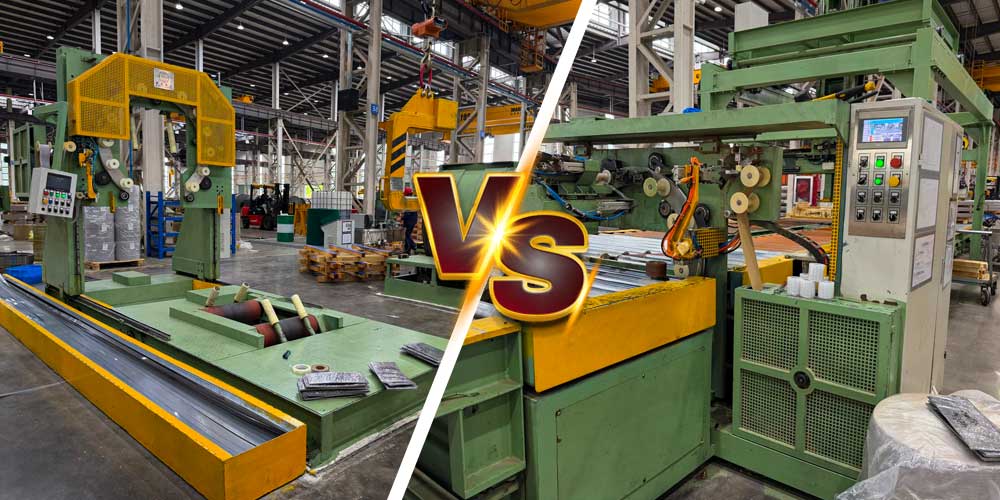
Two of the most common packaging systems are Horizontal Stretch Wrap Machines and Vertical Stretch Wrap Machines. Although both use stretch film to secure and protect steel coils, they differ significantly in coil orientation, wrapping method, handling equipment, and production applications.
This guide explains the technical differences between these two systems to help manufacturers choose the most suitable solution.
What Is a Stretch Wrap Machine?
A Stretch Wrap Machine is an automated packaging system that applies stretch film around a product under controlled tension. In the steel industry, these machines package:
- Slit steel coils
- Stainless steel coils
- Aluminum coils
- Copper coils
- Galvanized steel coils
- Cold rolled coils
- Hot rolled coils
The primary objectives are to:
- Protect coil surfaces
- Prevent corrosion
- Improve transportation safety
- Reduce packaging material consumption
- Increase packaging speed
- Enhance product appearance
What Is a Horizontal Stretch Wrap Machine?
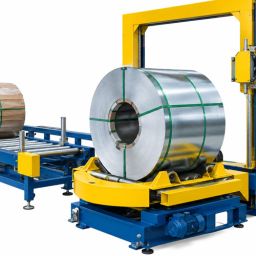
A Horizontal Stretch Wrap Machine packages coils while they remain in a horizontal (Eye-to-Wall) position. The coil is supported by rollers or conveyors and rotates during the wrapping process while a film carriage travels around the product.
Working Principle
The packaging process generally includes:
- Coil arrives from the production line.
- Coil is positioned on powered rollers.
- Stretch film is automatically clamped.
- Wrapping ring rotates around the coil.
- Film overlaps uniformly.
- Film is cut automatically.
- Coil exits to the unloading station.
Advantages
- High production speed
- Easy integration with slitting lines
- Suitable for heavy coils
- Continuous automatic operation
- Low operator intervention
- Stable coil handling
Typical Applications
Horizontal machines are commonly installed after:
- Steel Slitting Lines
- Cut-to-Length Lines
- Coil Storage Systems
- Steel Service Centers
- Automated Packaging Lines
What Is a Vertical Stretch Wrap Machine?
A Vertical Stretch Wrap Machine packages coils while standing in a vertical (Eye-to-Sky) position. The coil remains upright while the wrapping ring rotates around the outside diameter.
Working Principle
The process usually consists of:
- Crane places the coil vertically.
- Positioning device centers the coil.
- Wrapping ring rotates around the coil.
- Stretch film is tensioned automatically.
- Multiple wrapping layers are applied.
- Film is sealed and cut.
- Wrapped coil moves to storage.
Advantages
- Excellent package appearance
- Efficient use of floor space
- Ideal for export packaging
- Uniform wrapping quality
- Suitable for smaller and medium-sized coils
- Easy integration with robotic handling systems
Technical Comparison
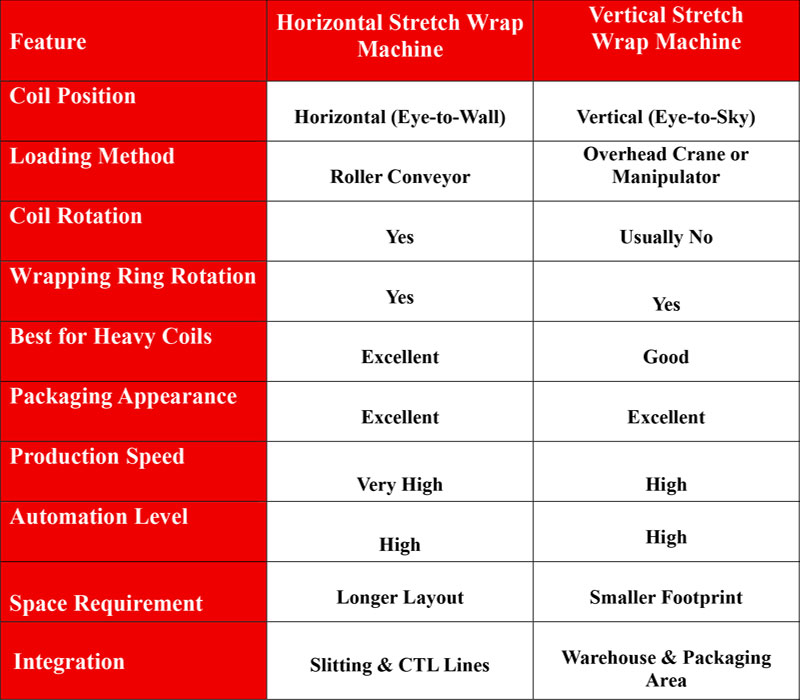
Eye-to-Wall vs. Eye-to-Sky Packaging
One of the biggest differences between the two systems is the orientation of the steel coil.
Eye-to-Wall
The coil eye faces sideways.
Common for:
- Slitting lines
- Automatic conveyors
- Continuous production
Benefits include:
- Easy conveyor transport
- High-speed packaging
- Stable coil movement
Eye to Sky
The coil eye faces upward.
Common for:
- Warehouse packaging
- Export preparation
- Crane handling
- Finished goods storage
Benefits include:
- Compact storage
- Improved lifting safety
- Better stacking flexibility
Stretch Film Control Technology
Modern wrapping machines use advanced film tension control to achieve consistent packaging quality.
Typical features include:
- Servo-controlled film carriage
- Adjustable stretch ratio
- Automatic overlap control
- Constant film tension
- Automatic film cutting
- Automatic film clamping
These technologies reduce film consumption while ensuring secure and reliable packaging.
Automation Features
High-end stretch wrap machines may include:
- PLC control system
- Touchscreen HMI
- Barcode scanning
- Automatic coil identification
- Conveyor synchronization
- Automatic weighing
- Edge protection feeding
- Moisture barrier application
- VCI film compatibility
- Remote diagnostics
Which Machine Should You Choose?
The best choice depends on your production process, coil handling method, and packaging requirements.
Choose a Horizontal Stretch Wrap Machine if you:
- Operate a steel slitting line
- Require continuous automatic production
- Process heavy steel coils
- Need high packaging throughput
- Use roller conveyors
Choose a Vertical Stretch Wrap Machine if you:
- Package finished coils in a warehouse
- Use overhead cranes for handling
- Prioritize compact floor space
- Require premium export packaging
- Process coils individually
Why Choose LOTOSSLITTING Stretch Wrap Machines?
LOTOSSLITTING designs and manufactures advanced coil packaging systems engineered for steel processing plants worldwide. Our stretch wrap machines are designed for reliability, automation, and long service life.
Key advantages include:
- Heavy-duty welded machine construction
- PLC-based intelligent control
- Servo-driven wrapping system
- Adjustable film tension control
- Automatic film cutting and clamping
- Integration with slitting and cut-to-length lines
- Custom machine configurations
- Worldwide installation and technical support
- One-year warranty with long-term after-sales service
Whether you require a standalone packaging station or a fully automated coil packaging line, LOTOSSLITTING provides customized solutions tailored to your production requirements.
Conclusion
Both Horizontal Stretch Wrap Machines and Vertical Stretch Wrap Machines provide reliable protection for steel coils, but they are optimized for different production environments. Horizontal systems excel in continuous, high-volume processing lines with conveyor handling, while vertical systems are ideal for warehouse operations and export packaging where cranes and compact layouts are preferred.
Selecting the right machine depends on coil orientation, production flow, handling equipment, and desired automation level. By understanding these technical differences, manufacturers can improve packaging efficiency, reduce material costs, and ensure superior protection throughout storage and transportation.
FAQ:
Horizontal stretch wrap machines are generally the preferred choice because they integrate directly with roller conveyors and continuous production lines.
The primary difference is the coil orientation. Horizontal machines wrap coils in the Eye-to-Wall position, while vertical machines wrap coils in the Eye-to-Sky position.
Typical materials include LLDPE stretch film, VCI film, moisture barrier film, kraft paper, woven fabric, and protective edge guards.
Yes. Modern systems can be integrated with conveyors, coil upenders, weighing stations, labeling units, strapping machines, and robotic handling systems to create a complete automated coil packaging solution.