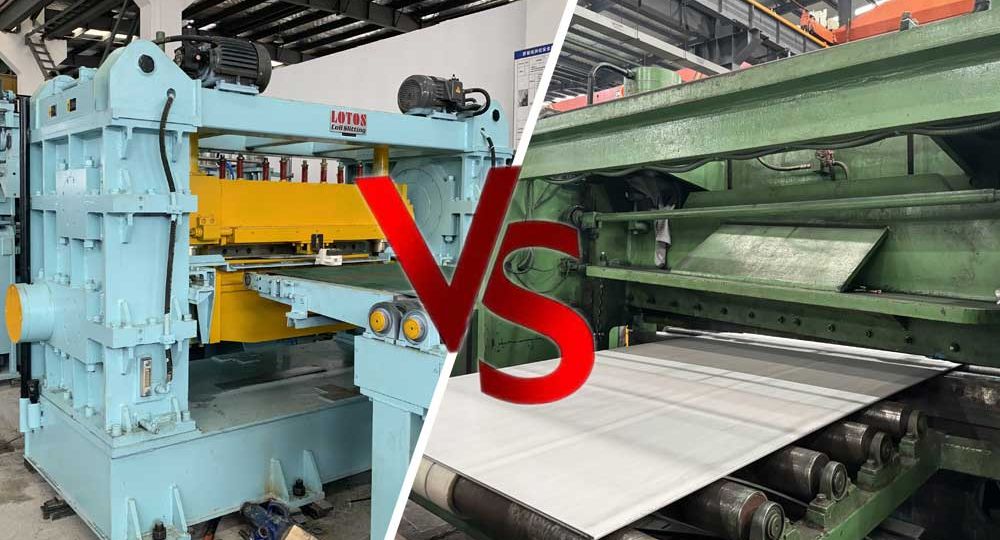
Choosing Between Start Stop and Flying Shear Cut to Length Lines
In a Cut-to-Length (CTL) line, the shearing system determines how continuously moving steel strip is cut into accurately sized sheets. The two commonly used configurations are Flying Shear CTL Lines and Start Stop Shear CTL Lines.
Although both systems perform the same fundamental function cutting a processed steel coil into sheets of predetermined length their operating principles, production speeds, equipment requirements, and application ranges are different.
Selecting the appropriate shear system is therefore an important engineering decision when designing or purchasing a steel coil cut to length line.
What Is a Cut to Length Line?
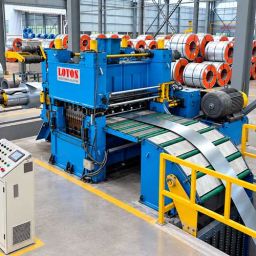
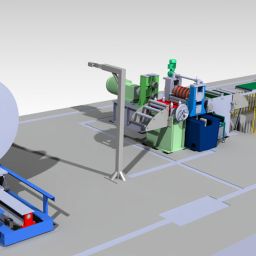
A Cut to Length Line processes steel coils by unwinding, leveling, feeding, measuring, and cutting the strip into individual sheets. Depending on the material and production requirements, a typical CTL line may include:
- Coil loading and entry equipment
- Hydraulic or mechanical decoiler
- Coil straightener
- Pinch and feeding rolls
- Leveling machine
- Servo measuring and feeding system
- Flying or start-stop shear
- Stacking system
- Sheet conveying and automatic stacking equipment
The main objective is to achieve consistent sheet length, flatness, squareness, surface quality, and production efficiency.
What Is a Flying Shear CTL Line?
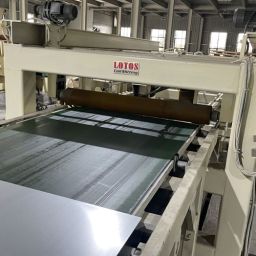
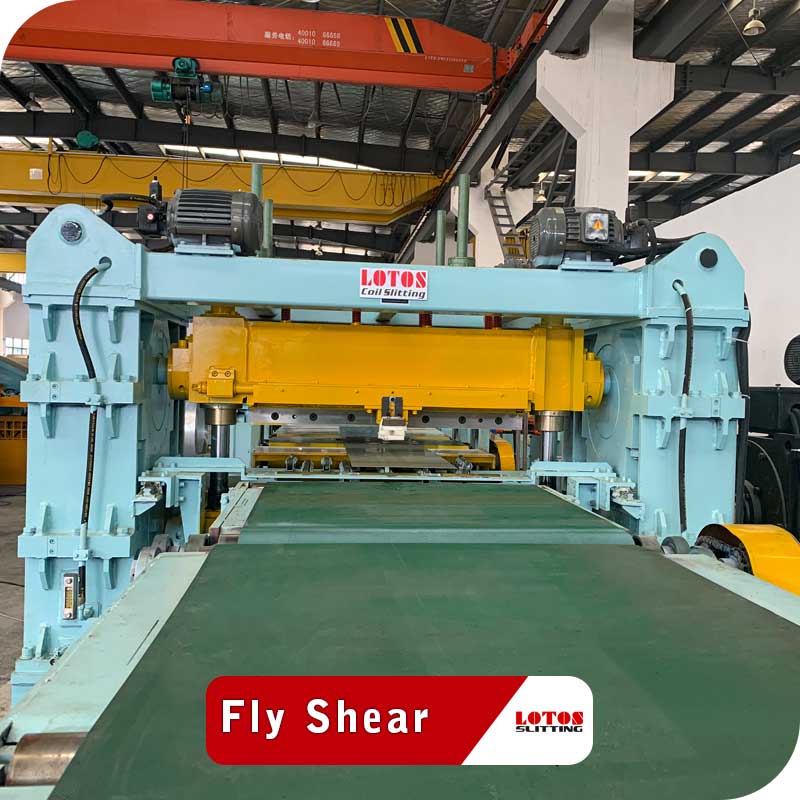
A Flying Shear CTL Line cuts the steel strip while it continues moving through the production line. The shear carriage or cutting mechanism synchronizes its movement with the strip before the blade performs the cut.
Because the material does not need to stop for every cut, the production process can operate continuously.
Working Principle
The basic operating sequence is:
Decoiling → Leveling → Feeding → Length Measurement → Flying Shearing → Conveying → Stacking
When the required sheet length is reached, the control system calculates the appropriate cutting position. The flying shear accelerates and travels with the moving strip during the cutting operation. After completing the cut, the shear returns to its initial position or prepares for the next cutting cycle.
This synchronized motion allows the line to maintain high production speeds while producing accurately sized sheets.
Advantages of Flying Shear CTL Lines
1. High Production Speed
The primary advantage of a flying shear is that the steel strip does not need to stop before each cut. This significantly reduces the non-productive time associated with acceleration and deceleration.
Flying shear systems are therefore particularly suitable for high speed cut to length production lines.
2. Continuous Production
Because the strip remains in motion, the complete CTL process can operate with a more continuous material flow. This improves overall line productivity and reduces interruptions.
3. Higher Production Capacity
For applications requiring large quantities of sheets, the continuous cutting principle can provide considerably higher output than a conventional start-stop system.
4. Suitable for Long Production Runs
Flying shear technology is particularly beneficial when the same material and sheet dimensions are produced continuously over extended production runs.
5. Reduced Stop-and-Start Effects
The elimination of repeated strip stopping reduces the mechanical and operational effects associated with frequent acceleration and deceleration of heavy steel coils.
What Is a Start Stop Shear CTL Line?
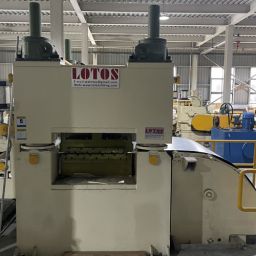
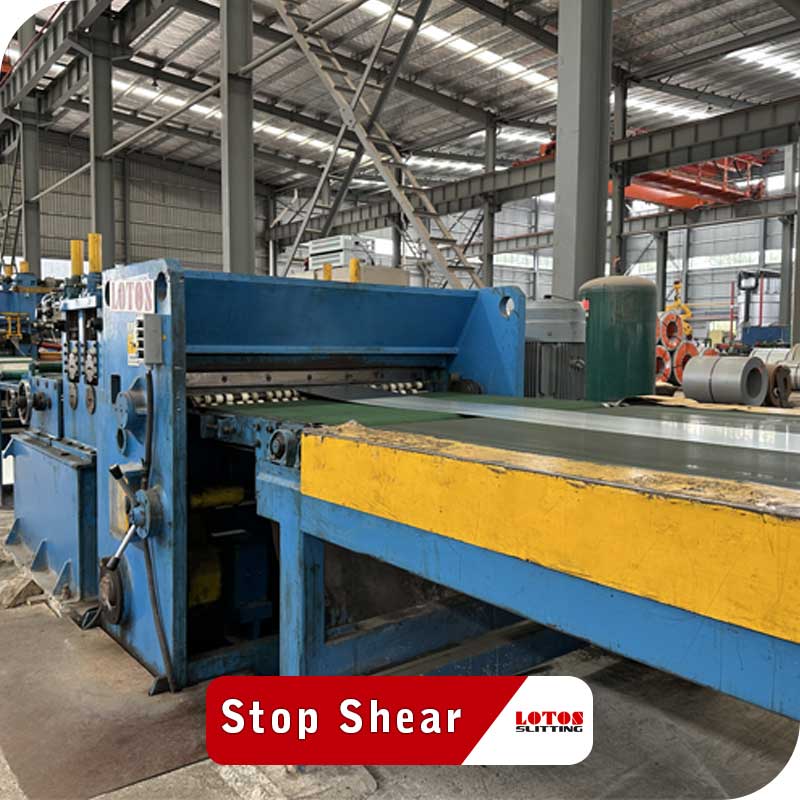
A Start-Stop Shear CTL Line stops the steel strip at the required cutting position before the shear cuts the material.
The operating sequence is generally:
Decoiling → Leveling → Feeding → Measuring → Strip Stop → Shearing → Strip Acceleration → Feeding → Next Cut
After the desired sheet length is measured, the feeding system stops the strip. The shear then cuts the stationary material. Following the cut, the strip resumes movement and the cycle repeats.
This is a relatively straightforward cutting method and is widely used for applications where extreme production speed is not the primary requirement.
Advantages of Start-Stop Shear CTL Lines
1. Simple Cutting Principle
The material is stationary during cutting, which makes the shear mechanism comparatively straightforward.
2. Good Cutting Accuracy
Because the strip stops before the cutting operation, controlling the exact cutting position can be relatively simple, particularly for standard production requirements.
3. Suitable for Lower and Medium Production Speeds
Start stop systems are appropriate when production capacity requirements are moderate and the additional complexity of a flying shear is not necessary.
4. Flexible Production
Start stop CTL lines can be suitable for production environments where sheet dimensions, materials, and batch quantities change frequently.
5. Lower System Complexity
Compared with a high speed flying shear system, a start-stop configuration can have fewer requirements for synchronization between the moving strip and shear carriage.
Key Technical Differences
Material Movement
The most fundamental difference is material movement during cutting.
- Flying Shear: The steel strip continues moving during the cutting operation.
- Start Stop Shear: The steel strip stops before the cutting operation.
Production Speed
Flying shear systems generally provide higher production speeds because they eliminate the need to stop the strip for every cut.
Start-stop systems are limited by the time required to decelerate, stop, shear, and accelerate the strip again.
Line Productivity
For high volume production, the continuous operation of a flying shear can provide higher throughput.
A start stop line may be more appropriate when production volume is moderate or when maximum line speed is not a critical requirement.
Control System
A flying shear requires precise synchronization between:
- Strip speed
- Shear carriage position
- Cutting position
- Sheet length
- Servo motion
- PLC control
Start-stop shearing generally requires less complex synchronization because the material is stationary during cutting.
Mechanical Requirements
A flying shear CTL line normally requires a more sophisticated servo-driven or synchronized shear mechanism capable of following the moving strip.
A start-stop shear can use a simpler mechanical arrangement because the strip is stationary during the cut.
Which CTL Shear System Should You Choose?
The correct configuration depends on the required production characteristics.
Choose a Flying Shear CTL Line When:
- High production speed is required.
- Large production volumes are expected.
- Continuous material flow is important.
- The application requires high productivity.
- The same or similar sheet sizes are produced continuously.
- Minimizing cycle time is a major objective.
Choose a Start Stop Shear CTL Line When:
- Production speed requirements are moderate.
- Production batches are relatively small.
- Frequent size changes are expected.
- A simpler cutting system is preferred.
- The investment needs to be optimized.
- Maximum throughput is not the primary requirement.
Material and Thickness Considerations
The selection of a shear system should not be based on speed alone. Material grade, strip width, thickness, yield strength, tensile strength, and sheet dimensions must also be considered.
For example, processing heavier or higher strength steel requires greater shear capacity and a suitable mechanical design. The required cutting force, blade geometry, drive system, machine rigidity, and control strategy must all be evaluated during CTL line engineering.
The required production speed should also be evaluated together with the coil width and sheet length. A short sheet length at high strip speed can result in a very high number of cutting cycles per minute, placing greater demands on the shear and control system.
Accuracy and Sheet Quality
Both flying shear and start stop shear systems can produce accurately cut sheets when properly designed and commissioned.
However, cutting accuracy depends on the complete CTL system rather than the shear alone. Important factors include:
- Servo feeding accuracy
- Encoder resolution
- Leveler performance
- Strip tension
- Material flatness
- Coil thickness consistency
- PLC control
- Shear synchronization
- Blade condition
- Machine rigidity
For high-speed production, synchronization becomes particularly important because even small timing or positioning errors can affect the final sheet length.
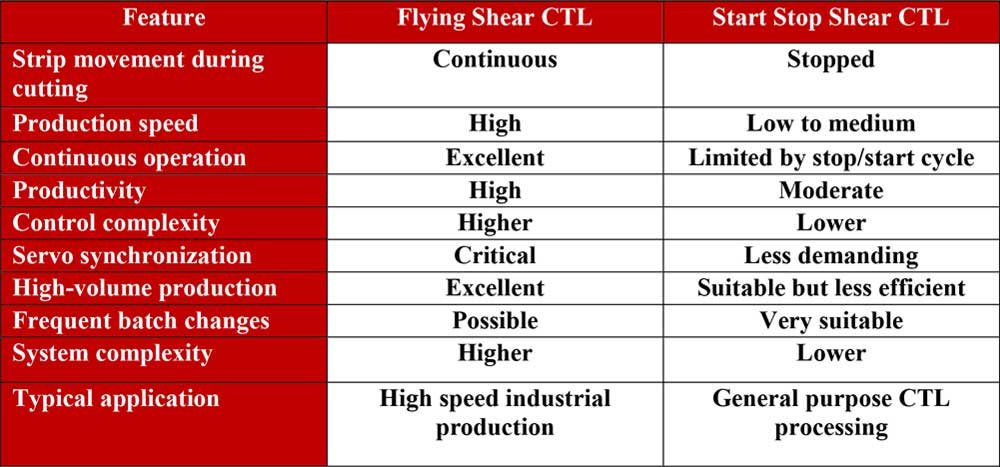
Flying Shear vs Start Stop Shear: Practical Comparison
Conclusion
The choice between a Flying Shear CTL Line and a Start-Stop Shear CTL Line should be based on production speed, material characteristics, sheet dimensions, production volume, accuracy requirements, and investment considerations.
A Flying Shear Cut-to-Length Line is generally the preferred solution for high-speed and high-volume steel coil processing because it cuts the moving strip without stopping the production flow.
A Start-Stop Shear CTL Line, on the other hand, offers a simpler and practical solution for applications where moderate production speed, flexibility, and straightforward operation are more important than maximum throughput.
For engineering a suitable steel cut to length line, the shear should therefore be selected as part of the complete line design rather than as an isolated component. The decoiler, leveler, servo feeding system, shear, stacking system, electrical controls, and material specifications must all be considered together to achieve the required production performance.
FAQ:
Yes. Each cutting cycle requires the strip to decelerate, stop, cut, and accelerate again. At high production rates, these repeated movements can limit overall line speed.
A Start-Stop Shear CTL Line is suitable when production speeds are moderate and flexibility, simpler operation, and lower system complexity are more important than maximum throughput.
A Flying Shear CTL Line is recommended when you require high production speed, continuous operation, high output, and reduced cycle time. It is especially suitable for large-volume steel sheet production.
A Flying Shear CTL Line generally provides higher production speeds because the strip does not need to stop for each cutting cycle. It is particularly suitable for high-volume steel coil processing.
A Start-Stop Shear CTL Line stops the steel strip at the required cutting position before the shear cuts it. After cutting, the strip accelerates again and continues to the next cutting position.