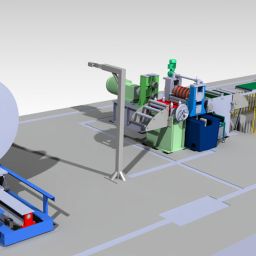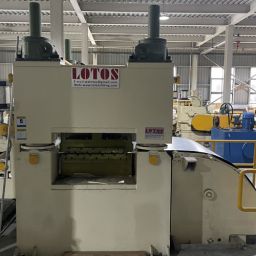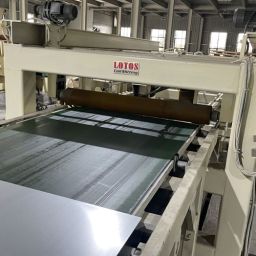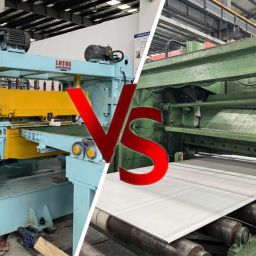
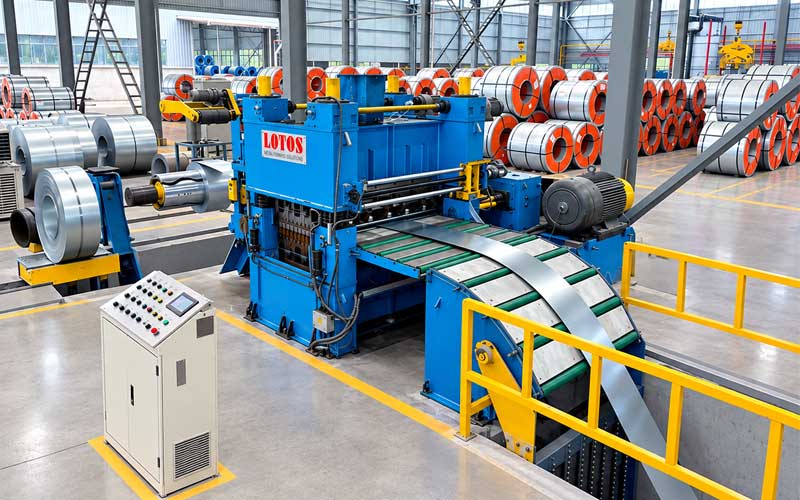
What is the cut to length line process?
A cut to length line converts coiled metal into flat sheets or blanks of defined length. While uncoiling, feeding, shearing and stacking are all essential stages, the quality of the finished sheet is largely determined by a single process: leveling. Material that leaves the coil is rarely flat. It carries curvature from coiling, internal stresses from rolling and, in many cases, shape defects introduced at the mill. If these conditions are not corrected, they appear as bow, wave, camber and twist in the cut sheet, resulting in rejected parts, unstable downstream processing and dissatisfied customers.
What is the cut to length line process?
Leveling is a mechanical process in which the strip is passed through a series of staggered work rolls arranged in alternating upper and lower positions. As the material travels through the roll set, it is subjected to controlled, repeated bending. Each successive bend is of decreasing intensity, which progressively reduces the difference in stress between the fibers of the material. The outcome is a strip with reduced coil set and a more uniform internal stress state, producing a flatter sheet after cutting.
In a cut to length line, the leveler is positioned after the uncoiler and before the measuring and shearing section, so that the material is flattened before it is cut to length.
Why Coil Material Is Not Flat
Understanding the sources of non flatness clarifies why leveling is indispensable.
1. Coil Set
When a strip is wound into a coil, it takes on the curvature of the coil diameter. The inner wraps in particular retain a permanent bend. Once uncoiled, the material continues to curve in the longitudinal direction, a condition known as coil set.
2. Residual Stress from Rolling
During hot and cold rolling, uneven reduction across the strip width creates differences in length between the center and the edges. These differences produce internal stresses that remain locked in the material.
3. Shape Defects
Typical shape defects originating at the mill include:
- Edge wave: The edges are longer than the center.
- Center buckle: The center is longer than the edges.
- Crossbow (cross curvature): The strip is curved across its width.
- Camber: The strip edge deviates from a straight line along its length.
4. Thermal and Processing Effects
Heat treatment, cooling, galvanizing, painting and slitting can all introduce or modify internal stress, further affecting flatness.
When such a strip is cut into sheets, the stresses are released unevenly, and the sheet may bow, twist or wave. Leveling addresses these conditions before the cut is made.
The Consequences of Inadequate Leveling
Insufficient or incorrect leveling affects both the cut to length line itself and the customer’s downstream operations.
Within the line:
- Inaccurate sheet length due to strip curvature affecting measurement
- Squareness errors and diagonal deviation in cut sheets
- Poor stacking, with uneven or unstable sheet piles
- Increased wear on shear blades from uneven material presentation
In downstream processing:
- Inconsistent feeding into laser cutting, punching and press operations
- Dimensional variation in stamped, bent or formed components
- Welding fit-up problems caused by warped blanks
- Visible waviness on finished surfaces, which is especially critical for appearance-grade and coated materials
- Higher scrap rates and customer claims
For manufacturers and service centers, flatness is a measurable quality attribute. Failure to meet flatness tolerances can result in rejected shipments and loss of business.
How Leveling Improves Sheet Quality
Removal of Coil Set
By bending the strip beyond its yield point in alternating directions, the leveler removes the permanent curvature imparted by coiling. The strip emerges straight along its length.
Reduction of Residual Stress
Controlled plastic deformation across the thickness balances internal stresses, which minimizes the tendency of the sheet to deform after shearing.
Improvement of Flatness
Properly adjusted roll penetration and back-up roll support correct edge wave and center buckle, producing sheets that lie flat on a measuring surface.
Stable Dimensional Accuracy
Flat material is measured and cut more accurately, improving length tolerance, squareness and repeatability from sheet to sheet.
Types of Levelers Used in Cut to Length Lines
Standard Roller Levelers (Coil Set Removers)
These machines use a relatively small number of larger rolls and are designed primarily to remove coil set and moderate shape defects. They are suitable for general purpose applications where flatness requirements are not extreme.
Precision Levelers
Precision levelers employ a greater number of smaller-diameter work rolls, supported by intermediate and back-up rolls. The smaller roll diameter and closer roll pitch permit deeper, more gradual plastic deformation, which corrects both coil set and shape defects. They are the preferred choice for thin gauges, high strength materials, stainless steel, aluminum and surface-critical products.
Key Factors That Determine Leveling Performance
1. Number of Rolls and Roll Diameter
A greater number of rolls with a smaller diameter allows more bending cycles within a shorter distance, which improves flatness correction, particularly for thin material.
2. Roll Pitch and Material Thickness
Roll spacing must be matched to the thickness range of the material. A leveler suited to thick plate will not perform adequately on thin strip, and the reverse is also true.
3. Roll Penetration Control
Accurate adjustment of entry and exit roll penetration governs the intensity of bending. Modern levelers provide precise, repeatable positioning, often with digital readouts or automatic setting from stored recipes.
4. Back-Up Roll Support
Back-up rolls prevent work-roll deflection across the strip width, ensuring that leveling action is uniform from edge to edge. Segmented back-up roll arrangements allow targeted correction of edge wave or center buckle.
5. Material Properties
Yield strength, thickness and surface condition directly influence the required penetration and the achievable flatness. Higher strength materials, including advanced high-strength steels, demand more rigid machine frames and greater drive power.
6. Roll Surface and Hardness
Hardened, ground and, where necessary, chrome-plated rolls resist wear and protect surface finish. Surface-sensitive materials such as stainless steel, pre-painted steel and aluminum may require additional protection to avoid marking.
7. Frame Rigidity and Drive Capacity
A rigid frame limits elastic deflection under load, and an adequately dimensioned drive system maintains stable strip transport through the leveler without slippage.
Leveling and the Rest of the Cut to Length Line
Leveling does not operate in isolation. Its effectiveness depends on correct interaction with other line components:
- Uncoiler and entry guiding: Stable strip alignment into the leveler prevents uneven loading of the rolls.
- Loop control: A properly managed loop between the leveler and the feeder isolates speed differences and prevents tension that could reintroduce shape errors.
- Feeder and shear: Flat, stress balanced strip is easier to measure and cut precisely, improving length accuracy and edge quality.
- Stacker: Flat sheets produce neat, stable stacks that are safer to handle and ship.
When these elements are engineered as a coordinated system, the line delivers consistent quality at higher speeds with less operator intervention.
Best Practices for Effective Leveling
- Select a leveler specified for the actual thickness, width and yield strength range to be processed.
- Set roll penetration according to material type and thickness, and store proven settings for repeat jobs.
- Inspect sheets regularly using a flat reference surface or flatness measuring equipment.
- Maintain work rolls and back-up rolls, checking for wear, surface damage and contamination.
- Keep bearings, lubrication and drive components in good condition.
- Train operators to recognize the visual signs of under-leveling and over-leveling, and to adjust accordingly.
Over-leveling is as undesirable as under leveling. Excessive deformation can work harden the material, alter mechanical properties and in some cases introduce new shape defects. The objective is correct, controlled leveling rather than maximum deformation
Conclusion
Leveling is a foundational process in any cut to length line. It removes coil set, balances residual stress and corrects shape defects, enabling the production of flat, dimensionally accurate sheets that perform reliably in downstream operations. Inadequate leveling leads to measurement errors, poor stacking, rejected parts and lost customer confidence, while a correctly specified and well-maintained leveler improves yield, productivity and product quality.
LotosSlitting designs and supplies cut to length lines and coil-processing equipment engineered for precision and durability. Contact our technical team to discuss your material range, flatness requirements and production targets, and receive a leveling solution suited to your application.
FAQ :
A leveler can correct a substantial proportion of coil set and shape defects, but severe mill-originated defects may be only partially corrected. The achievable result depends on the material, thickness, machine design and setting.
When rolls are clean, correctly finished and properly set, leveling should not damage the surface. For sensitive materials, surface-protection measures and roll maintenance are essential.
Settings should be verified whenever material grade, thickness or coil source changes, and sheet flatness should be checked periodically during production.
The terms are often used interchangeably in industry. In general, a leveler corrects flatness and shape defects across the strip, while a straightener or coil-set remover primarily addresses longitudinal curvature.