
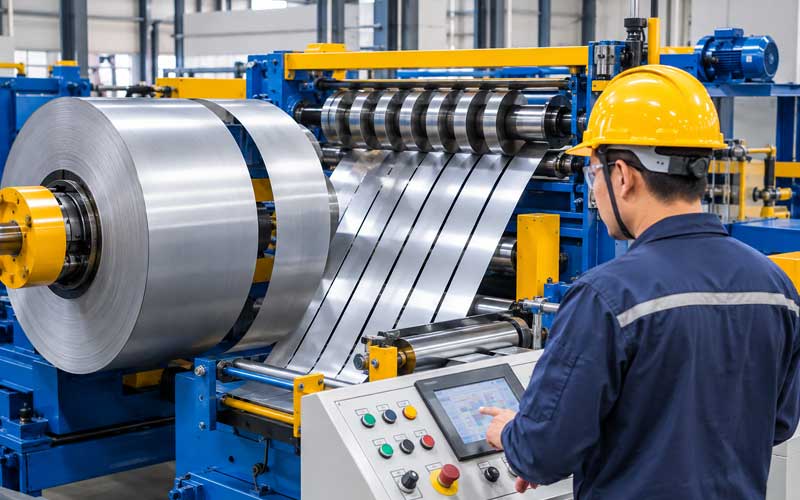
A Complete Guide to Safe and Efficient Operation
Operating a metal slitting line requires technical knowledge, attention to safety, and practical experience. Proper slitting line operator training helps ensure that operators can set up, operate, monitor, and maintain the equipment correctly while achieving consistent strip quality and production efficiency.
A trained operator plays an important role in controlling material flow, maintaining slitting accuracy, minimizing scrap, and responding to production problems. For modern steel, stainless steel, and aluminum processing lines, operator training should cover both machine operation and production quality requirements.
What Is Slitting Line Operator Training?
Slitting line operator training is a structured process that teaches operators how to safely and efficiently operate a metal slitting line. The training normally covers the complete production process, from coil loading and decoiling to slitting, tension control, recoiling, and finished coil handling.
Depending on the machine configuration, training may include:
- Coil loading and decoiler operation
- Strip feeding and threading
- Slitter head setup
- Slitting knife installation and adjustment
- Spacer selection and arrangement
- Tension control
- Recoiler operation
- Edge trimming and scrap handling
- Production monitoring
- Quality inspection
- Basic troubleshooting
- Routine maintenance
- Machine safety procedures
The objective is to develop operators who can understand the relationship between machine settings, material properties, production speed, and finished-strip quality.
Why Is Operator Training Important for a Slitting Line?
A metal slitting line can contain multiple mechanical, hydraulic, pneumatic, and electrical systems. Incorrect operation can result in poor strip quality, equipment damage, excessive scrap, or unsafe working conditions.
Effective operator training provides several important benefits.
Improved Production Efficiency
Trained operators can correctly adjust machine parameters and identify production problems at an early stage. This helps reduce unnecessary downtime and improves overall line productivity.
Better Slitting Quality
Accurate knife positioning, proper spacer selection, and correct tension settings are essential for producing strips with consistent widths and clean edges.
Reduced Material Scrap
Incorrect setup can produce excessive side trim, burrs, telescoping coils, or dimensional variation. Proper training helps operators select appropriate settings before production begins.
Improved Equipment Protection
Operators who understand machine limits are less likely to overload the slitting head, recoiler, decoiler, or drive system.
Safer Production
Safety should be a fundamental part of operator training. Operators need to understand hazardous areas, emergency stops, moving components, rotating knives, and safe coil-handling procedures.
Main Topics Covered in Slitting Line Operator Training
A comprehensive training program should cover the entire production cycle.
1. Understanding the Slitting Line
Before operating the equipment, operators should understand the function of the main machine sections.
A typical metal slitting line may include:
- Coil car
- Hydraulic or mechanical decoiler
- Leveler or straightener
- Pinch rolls
- Slitter head
- Scrap winder
- Tension unit
- Recoiler
- Coil separator
- Coil discharge system
Understanding how these sections work together allows the operator to identify problems more effectively.
2. Coil Loading and Decoiler Operation
Operators must learn how to safely load the master coil onto the decoiler and correctly position it before production.
Training should cover:
- Coil weight and width verification
- Coil inner diameter and outer diameter
- Coil direction
- Mandrel expansion and retraction
- Coil centering
- Coil car operation
- Strip head preparation
Incorrect coil positioning can create feeding problems and affect the stability of the entire slitting process.
3. Strip Threading and Feeding
Strip threading is one of the important practical skills for a slitting line operator.
The operator should understand how to guide the strip through the relevant machine sections without damaging the material or creating unsafe conditions.
Training should include:
- Strip feeding procedures
- Pinch-roll operation
- Correct threading direction
- Strip alignment
- Safe manual intervention
- Communication between operators during threading
Automated threading systems may simplify the process, but operators still need to understand the underlying procedure.
4. Slitter Head Setup
The slitter head is one of the most important sections of the production line. Incorrect knife positioning can directly affect strip width, edge quality, and production stability.
Operators should learn how to:
- Install slitting knives correctly
- Select suitable spacers
- Calculate knife and spacer arrangements
- Set required strip widths
- Check knife positioning
- Verify shaft and locking conditions
- Inspect knives for damage or wear
For high-precision applications, the setup should be performed according to the machine manufacturer’s technical requirements.
5. Slitting Knife and Spacer Management
Knife condition has a direct influence on slitting performance. Worn or incorrectly installed knives can increase burrs, edge deformation, and material loss.
Operator training should therefore include:
- Knife inspection
- Knife replacement
- Knife sharpening requirements
- Spacer inspection
- Correct spacer arrangement
- Knife clearance considerations
- Proper storage and handling of slitting knives
Operators should never make knife adjustments while rotating components are in motion.
6. Tension Control
Tension control is critical for producing stable and properly wound slit coils.
Insufficient or excessive tension can lead to problems such as:
- Telescoping coils
- Loose winding
- Strip deformation
- Edge damage
- Coil instability
- Uneven winding
Operators should understand how decoiler, slitter, tension unit, and recoiler settings interact during production.
7. Recoiler Operation
The recoiler collects the slit strips into finished coils. Correct recoiler settings are essential for maintaining coil shape and winding quality.
Training should cover:
- Recoiler mandrel operation
- Coil separation
- Tension adjustment
- Coil winding
- Coil positioning
- Finished coil discharge
- Safe handling of slit coils
The operator should monitor the coil throughout production instead of waiting until the end of the process to identify winding problems.
8. Slitting Line Safety Training
Safety training is an essential part of every slitting line operator training program.
Operators should understand the hazards associated with:
- Rotating slitting knives
- Moving coils
- Hydraulic systems
- Pneumatic equipment
- Electrical systems
- High tension strip
- Coil lifting equipment
- Automatic machine movements
Operators should know the location and correct use of emergency stop devices and should follow the machine’s lockout/tagout and maintenance procedures where applicable.
Personal protective equipment should be used according to the site’s risk assessment and safety requirements.
9. Basic Troubleshooting Training
Operators should be able to recognize common production problems and determine whether an issue can be corrected through normal operating adjustments or requires maintenance intervention.
Common slitting-line problems include:
Excessive Burr
Possible causes include incorrect knife clearance, damaged knives, improper knife positioning, or unsuitable cutting conditions.
Telescoping Coil
Possible causes include unstable tension, strip misalignment, improper separator positioning, or incorrect recoiler settings.
Uneven Strip Width
Possible causes include incorrect knife setup, material movement, or inaccurate positioning of the slitting tooling.
Strip Scratches
Possible causes may include damaged rollers, contamination, improper strip guidance, or contact with machine components.
Loose Recoiling
Insufficient winding tension or incorrect recoiler settings can result in loose finished coils.
Operators should follow the manufacturer’s troubleshooting procedures rather than making unauthorized machine modifications.
10. Preventive Maintenance Training
Operators are often the first people to identify abnormal machine conditions. Basic preventive maintenance training can therefore help reduce unexpected downtime.
Routine checks may include:
- Lubrication points
- Hydraulic oil condition
- Pneumatic pressure
- Rollers and guides
- Slitting knives
- Bearings
- Electrical indicators
- Sensors
- Safety devices
- Fasteners and mechanical connections
Maintenance procedures should always follow the equipment manufacturer’s instructions.
Slitting Line Operator Training Checklist
A practical operator training checklist can include the following stages:
- Understand the complete slitting line layout.
- Identify the function of each major machine section.
- Learn coil loading procedures.
- Practice safe strip threading.
- Learn slitter head setup.
- Understand knife and spacer arrangements.
- Learn tension-control principles.
- Operate the recoiler correctly.
- Perform basic quality inspections.
- Identify common production problems.
- Follow emergency and safety procedures.
- Perform routine operator-level inspections.
- Record production and quality information.
- Follow maintenance and shutdown procedures.
How Long Does Slitting Line Operator Training Take?
The required training period depends on the complexity of the slitting line, the operator’s previous experience, automation level, material type, and production requirements.
A basic training program may focus on machine operation and safety, while advanced training can include tooling setup, process optimization, quality control, troubleshooting, and maintenance.
For a new production line, practical training during installation and commissioning can be particularly valuable because operators can learn directly on the equipment they will operate.
On-Site Training for Slitting Line Operators
For new slitting equipment, on-site training can provide significant advantages. Operators can learn the actual control system, machine configuration, tooling arrangement, and production procedures used by their facility.
A professional training program can combine:
- Theoretical instruction
- Machine demonstrations
- Supervised operation
- Slitter setup practice
- Quality inspection
- Troubleshooting exercises
- Safety training
- Maintenance guidance
This approach helps operators gain practical experience before independently operating the production line.
Best Practices for Slitting Line Operators
Experienced operators should consistently follow standardized operating procedures.
Key best practices include:
- Verify the production order before setup.
- Confirm coil specifications before loading.
- Inspect knives and spacers before production.
- Check strip alignment.
- Use appropriate machine parameters for the material.
- Monitor tension throughout the process.
- Inspect finished strips regularly.
- Stop the line when abnormal conditions occur.
- Record production and quality data.
- Never bypass safety devices.
- Perform routine inspections before and after production.
Conclusion
Slitting line operator training is an important part of achieving safe, stable, and efficient metal coil processing. A properly trained operator understands the complete production process, from coil loading and slitter setup to tension control, recoiling, quality inspection, troubleshooting, and routine maintenance.
For steel, stainless steel, aluminum, galvanized steel, and other metal materials, operator knowledge can directly influence production efficiency, slit-edge quality, coil winding performance, material utilization, and equipment reliability.
For manufacturers investing in a new metal slitting line, operator training should be considered an essential part of machine commissioning and long-term production support. A combination of theoretical instruction, practical operation, safety procedures, and technical guidance provides operators with the knowledge required for reliable day-to-day production.
FAQ:
Operators should learn coil loading, strip threading, slitter head setup, knife and spacer arrangement, tension control, recoiling, quality inspection, troubleshooting, and safety procedures.
Operators should understand machine guarding, emergency stops, coil-handling procedures, rotating components, hydraulic and electrical hazards, and applicable lockout/tagout procedures.
Basic operator-level maintenance and inspection can be included, such as checking knives, rollers, lubrication points, sensors, hydraulic systems, and safety devices.
Slitting line operator training teaches personnel how to safely set up, operate, monitor, and maintain a metal slitting line for efficient and consistent coil processing.
