
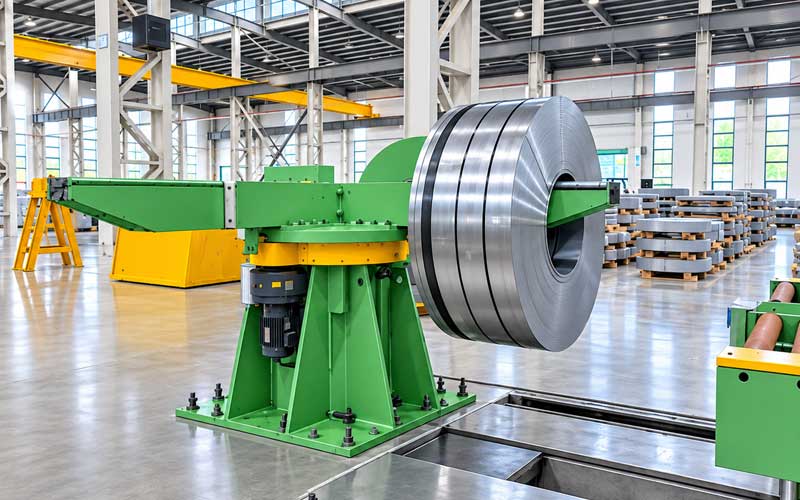
Production, Applications and Quality Requirements
Stainless steel slit coil is a fundamental raw material for manufacturers in the automotive, appliance, construction, food processing, and medical equipment industries. It is produced by cutting a wide master coil into several narrower strips, each wound into a separate coil of precise width. Because stainless steel is strong, corrosion resistant and visually sensitive, the quality of the slitting process has a direct effect on the quality of the final product.
What Is Stainless Steel Slit Coil?
Stainless steel slit coil is a narrow width coil obtained from a wide stainless steel master coil by means of a slitting line. The master coil is uncoiled, cut longitudinally by circular knives into strips of the required width, and then recoiled under controlled tension.
Slit coil is supplied in a wide range of widths and thicknesses. It allows downstream manufacturers to receive material that is already sized for their stamping, roll forming, tube making or fabrication processes, which reduces waste and shortens production time.
How Stainless Steel Slit Coil Is Produced
A modern slitting line carries out the process in several coordinated stages.
- Uncoiling: the master coil is loaded onto a decoiler, which feeds the strip into the line at a steady speed.
- Feeding and guiding: a pinch roll machine and side guides keep the strip centered and aligned as it enters the slitter.
- Slitting: upper and lower circular knives, set with accurate spacers, shear the strip into the required widths.
- Scrap handling: edge trim is removed and wound or chopped by a scrap handling unit.
- Tensioning: a tension stand separates the slit strips and holds them under uniform tension.
- Recoiling: a recoiler winds the strips into tight, even coils that are ready for packing.
Each stage must be well controlled, because a fault at any point can appear as a defect in the finished coil.
Main Applications of Stainless Steel Slit Coil
Stainless steel slit coil is used across many sectors:
- Tube and pipe production: welded stainless tubes and pipes are formed directly from slit strips.
- Home appliances: washing machines, refrigerators and kitchen equipment.
- Automotive industry: exhaust systems, trim and structural components.
- Construction and architecture: cladding, handrails, elevators and decorative panels.
- Food and medical equipment: hygienic surfaces that resist corrosion and are easy to clean.
- Stamping and fabrication: precision parts, springs and electrical components.
Key Quality Factors of Stainless Steel Slit Coil
The performance of slit coil in downstream production depends on several measurable characteristics.
Width Tolerance
Accurate width is essential for tube mills, roll forming lines and stamping dies. Precision knives, correct spacers and a rigid slitter ensure consistent width along the entire coil length.
Edge Quality
Clean edges with minimal burr reduce the risk of cracking during forming, protect tooling and improve weld quality. Burr height depends on knife clearance, knife overlap, knife condition and material thickness.
Surface Protection
Stainless steel is sensitive to scratches, particularly in bright and mirror finishes. Well polished rolls, clean guides and, where required, protective film or paper interleaving help to preserve the surface.
Coil Shape and Winding
Camber, edge waviness and telescoping affect later processing. Correct strip tension and a precise recoiler produce straight strips and neat, tightly wound coils.
Flatness and Stress
Strip flatness influences how the material behaves during forming. Proper line setup and, where necessary, leveling before slitting help to control residual stress.
Slitting Line Requirements for Stainless Steel
Stainless steel has higher strength and work hardening behavior than carbon steel, so the slitting line must be designed accordingly. Important requirements include:
- Rigid construction: a robust frame and strong arbors resist the higher cutting forces.
- High-grade knives: hardened tool steel or carbide knives maintain a sharp edge and extend knife life.
- Accurate knife setting: correct clearance and overlap for each thickness keep burrs low.
- Gentle strip handling: protective roll coatings and controlled pressure preserve the surface.
- Stable tension control: consistent tension gives uniform coils without scratches or telescoping.
LotosSlitting designs slitting lines with these requirements in mind, so that processors can achieve high precision and consistent quality on stainless steel.
How to Choose a Reliable Stainless Steel Slit Coil Supplier or Equipment Partner
Whether you purchase slit coil or process it yourself, certain criteria should guide your decision:
- Material certification: confirm grade, chemical composition and mechanical properties through mill test certificates.
- Tolerance capability: verify the supplier’s width, thickness and edge quality standards.
- Surface quality control: ask how the surface is protected during slitting and packing.
- Packaging: proper packing prevents damage during storage and transport.
- Technical support: experienced engineers can help to resolve process and quality questions.
Conclusion
Stainless steel slit coil is a precisely processed material that supports a wide range of industries. Its quality depends on the master coil, the slitting line and the control of tension, edges and surface throughout the process. A well designed slitting line and correct process settings give accurate width, clean edges and a protected surface, which together reduce waste and improve efficiency downstream.
LotosSlitting provides customized slitting lines and cut to length lines for stainless steel and other metals, supported by professional engineering, installation and after sales service.
Contact Lotos Slitting to discuss your stainless steel coil processing requirements.
