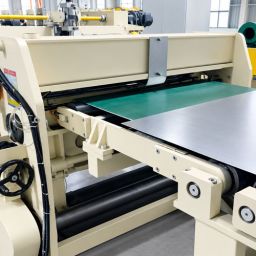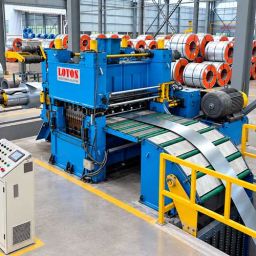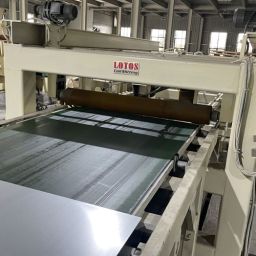
What IS IT and How DOES It Works?
A Stretch Levelling Cut to Length Line is an advanced steel coil processing system designed to uncoil, level, stretch, cut, and stack metal sheets to precise lengths. Compared with conventional roller levelling, stretch levelling applies controlled longitudinal tension to the strip while it is being bent, helping reduce residual stress and improve flatness.
For manufacturers processing high strength steel, stainless steel, aluminum, and other demanding materials, the combination of stretch levelling and cut to length processing provides an efficient method for producing flat sheets with consistent dimensions and improved shape quality.
What Is a Cut to Length Line?
A Cut to Length (CTL) Line is a coil processing machine that converts a continuous metal strip from a coil into individual sheets of predetermined length.
The basic process is:
Steel Coil → Uncoiling → Leveling → Measuring → Cutting → Stacking
Unlike a slitting line, which divides a wide coil into narrower strips, a CTL line maintains the strip width and cuts it into sheets according to the required length.
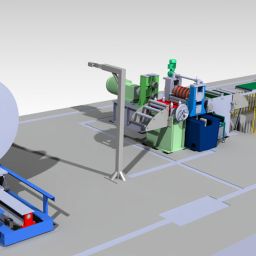
A typical CTL line may include:
- Coil loading system
- Coil car
- Hydraulic or mechanical decoiler
- Pinch rolls
- Straightener or leveler
- Servo measuring system
- Shearing machine
- Conveyor
- Stacking system
- PLC and HMI control system
The exact configuration depends on the material grade, coil dimensions, thickness, production speed, required flatness, and sheet size.
How Does a Cut to Length Line Work?
The operation of a CTL line can be divided into several continuous stages.
1. Coil Loading
The steel coil is positioned onto a coil car and transferred to the decoiler.
The coil car helps align the coil with the production centerline and allows controlled loading of different coil weights and dimensions.
2. Uncoiling
The decoiler expands inside the coil and rotates to release the steel strip.
Pinch rolls guide the strip into the processing section while maintaining stable strip tension.
For heavy-gauge applications, the decoiler and coil-handling equipment must be designed to withstand high coil weights and strip tension.
3. Strip Feeding
After uncoiling, the strip passes through feeding and guiding equipment.
Servo-controlled feeding systems can improve length accuracy by controlling the amount of material delivered to the cutting section.
4. Leveling
The strip passes through a leveling machine to correct unwanted shape defects such as:
- Edge wave
- Center buckle
- Longitudinal curvature
- Coil set
- Crossbow
Conventional roller leveling uses a series of rollers with controlled penetration to repeatedly bend the material and improve flatness.
However, materials with high yield strength or significant residual stress may require a more advanced process.
What Is Stretch Levelling?
Stretch levelling is a metal flattening process in which the strip is subjected to controlled longitudinal tension while passing through a series of leveling rolls.
The combination of:
Tension + Controlled Bending
causes selected portions of the material to undergo controlled plastic deformation.
This can redistribute residual stresses and produce significantly improved flatness.
Stretch levelling is particularly useful for materials where conventional roller leveling alone cannot provide the required flatness and stress condition.
How Does Stretch Levelling Work?
The stretch levelling section typically consists of tensioning equipment and a leveling roll cassette.
A simplified process is:
Entry Tension → Controlled Bending → Plastic Deformation → Stress Redistribution → Exit Tension
The strip is placed under controlled tension between the entry and exit sections. While tension is maintained, the material passes over small-diameter leveling rolls.
Because the strip is simultaneously stretched and bent, portions of the material enter the plastic deformation range. This helps reduce internal stress differences across the strip.
The result is a flatter and more stable sheet.
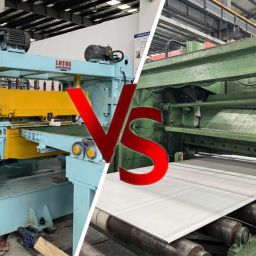
Stretch Levelling vs. Conventional Roller Levelling
Both processes improve material flatness, but their operating principles are different.
Conventional Roller Levelling
Roller leveling primarily uses repeated bending and reverse bending.
It is effective for many standard carbon-steel and sheet-processing applications.
Stretch Levelling
Stretch leveling combines tensile force with repeated bending.
It is particularly advantageous when the application requires:
- Improved flatness
- Lower residual stress
- Better dimensional stability
- Processing of high-strength materials
- Improved downstream fabrication performance
Therefore, the appropriate leveling technology should be selected according to the material grade, thickness, yield strength, width, and final product requirements.
Stretch Levelling Cut-to-Length Line Process
A complete stretch levelling CTL line can generally follow this production sequence:
Depending on the application, additional equipment such as an accumulator, edge guide, inspection table, scrap handling system, or automatic stacking equipment can be incorporated.
Cut to Length Shearing Systems
The cutting section is responsible for separating the continuously processed strip into individual sheets.
Two common approaches are used in CTL systems.
Start Stop Shearing
In a start-stop CTL line, the strip stops before the shear performs the cut.
The basic sequence is:
Feed → Stop → Cut → Feed → Stop → Cut
This configuration is suitable for applications where production speed is moderate and high cutting accuracy is required.
Flying Shearing
A flying shear cuts the strip while it continues moving through the line.
The shear follows the strip during the cutting operation and then returns to its starting position.
The process can be represented as:
Continuous Feeding → Synchronized Flying Cut → Continuous Feeding
Flying shearing can significantly increase production efficiency because the material does not need to stop for every cut.
Leveling Cut to Length Line
A conventional Leveling Cut-to-Length Line uses a roller leveler rather than a stretch leveling system.
Its general configuration is:
Decoiler → Pinch Rolls → Leveler → Measuring → Shear → Conveyor → Stacker
The leveler usually contains multiple precision rolls. By controlling roll penetration and bending conditions, the machine corrects coil set and other flatness problems.
Leveling CTL lines are widely used for processing:
- Carbon steel
- Galvanized steel
- Stainless steel
- Aluminum
- Pre-painted steel
- Other sheet and strip materials
The machine configuration should be selected according to the material characteristics and required flatness tolerance.
Stretch Levelling CTL vs. Leveling CTL
The main difference is the method used to improve material flatness.
| Feature | Stretch Levelling CTL | Conventional Leveling CTL |
|---|---|---|
| Main principle | Tension + bending | Repeated bending |
| Residual stress control | Excellent | Good |
| Flatness improvement | Very high | High |
| High-strength materials | Highly suitable | Application dependent |
| Dimensional stability | Excellent | Good |
| Equipment complexity | Higher | Lower |
| Investment | Generally higher | Generally lower |
| Typical application | High-quality sheet processing | General sheet production |
Stretch levelling is generally selected when both flatness and residual stress control are critical.
Main Components of a Stretch Levelling Cut-to-Length Line
Decoiler
The decoiler supports and unwinds the incoming steel coil. Hydraulic expansion and heavy-duty construction are commonly used for industrial applications.
Entry Pinch Rolls
Pinch rolls introduce the strip into the leveling section and help maintain stable strip feeding.
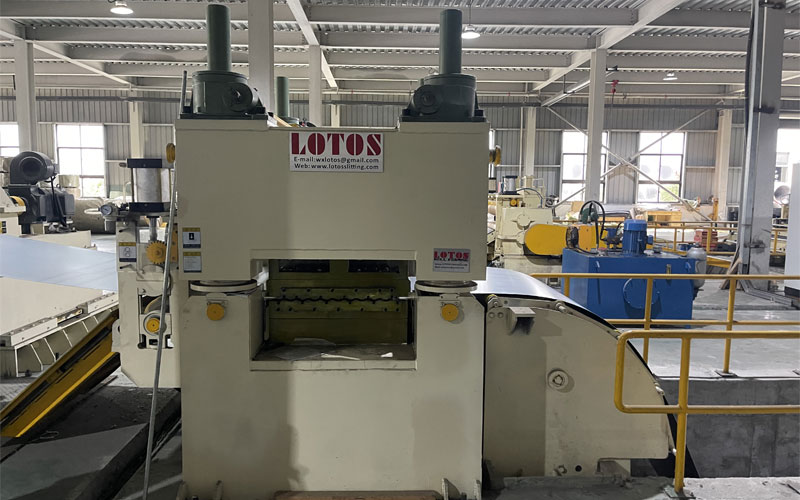
Stretch Levelling Unit
This is the core component of the line. It applies controlled tension and bending to improve flatness and reduce residual stress.
Servo Feeding System
A servo-driven feeding system controls strip movement and helps achieve accurate sheet lengths.
Flying or Start-Stop Shear
The shear cuts the strip into individual sheets according to the programmed length.
Conveyor
After cutting, sheets are transferred toward the stacking section.
Stacking System
The stacking system collects and aligns finished sheets. Automatic stacking can improve productivity and reduce manual handling.
PLC and HMI
The electrical control system coordinates:
- Line speed
- Strip tension
- Leveling parameters
- Feeding length
- Shearing synchronization
- Stacking operations
- Safety interlocks
Advantages of a Stretch Levelling Cut to Length Line
A properly designed stretch levelling CTL line can provide several important production advantages.
1. Improved Flatness
Controlled stretching and bending can produce sheets with excellent flatness.
2. Residual Stress Reduction
The process can reduce internal stress variations that may cause distortion during subsequent fabrication.
3. Better Dimensional Stability
Stress-relieved material is less likely to change shape during downstream processes such as cutting, welding, machining, or forming.
4. High Production Efficiency
When combined with automated feeding, flying shearing, and automatic stacking, the line can achieve continuous and efficient production.
5. Consistent Sheet Length
Servo measuring and synchronized shearing systems provide repeatable cutting accuracy.
6. Reduced Manual Handling
Automated conveying and stacking systems reduce operator intervention and improve workplace efficiency.
Applications of Stretch Levelling Cut to Length Lines
Stretch levelling CTL lines are commonly considered for applications where high flatness and stress control are important.
Typical industries include:
- Automotive components
- Construction equipment
- Agricultural machinery
- Steel service centers
- Heavy machinery
- General fabrication
- Appliance manufacturing
- Shipbuilding
- Transportation equipment
- Precision sheet-metal processing
The final configuration should always be determined based on the actual material and production requirements.
How to Choose a Stretch Levelling Cut to Length Line
Several technical parameters should be evaluated before selecting the equipment.
Material
Specify the material grade and type, such as:
- Carbon steel
- High-strength steel
- Stainless steel
- Aluminum
- Galvanized steel
Thickness
The line must be designed for the minimum and maximum strip thickness.
Coil Width
Maximum and minimum coil width determine the working width of the leveling and cutting equipment.
Coil Weight
The decoiler, coil car, and handling equipment must support the maximum coil weight.
Production Speed
Required output determines the appropriate line speed and whether flying shearing is necessary.
Sheet Length
The required minimum and maximum cut length must be considered when designing the feeding and cutting system.
Flatness Requirement
If the customer requires extremely flat and stress-relieved sheets, stretch leveling may provide advantages over conventional roller leveling.
Conclusion
A Stretch Levelling Cut to Length Line combines controlled strip tension, precision bending, accurate measuring, shearing, and automatic stacking to produce flat sheets from steel coils.
The key distinction between a stretch levelling CTL line and a conventional leveling CTL line is that stretch levelling applies longitudinal tension while bending the strip, allowing improved control of residual stresses and material flatness.
For applications requiring high-quality flat sheets, stable dimensions, and controlled residual stress, stretch levelling technology can provide a significant technical advantage. The correct line configuration depends on material grade, thickness, width, coil weight, production speed, cutting accuracy, and required flatness.
LOTOSSLITTING can configure coil processing and cut-to-length solutions according to specific material and production requirements, including leveling, stretch levelling, flying shearing, and automatic stacking systems.
FAQ:
The line typically feeds the steel coil through an uncoiler, levelling and feeding equipment, stretch leveller, measuring system, and cutting machine. During stretch levelling, the strip is subjected to controlled tension and elongation, which reduces internal stresses and improves flatness. The processed strip is then cut into sheets according to the programmed length.
Depending on the machine configuration, a Stretch Levelling Cut to Length Line can process materials such as:
- Carbon steel
- Stainless steel
- Galvanized steel
- Pre-painted steel
- High-strength steel
- Other metal strips with suitable mechanical properties
The actual material range depends on thickness, width, yield strength, and the specifications of the line.
Conventional roller levelling primarily corrects strip shape by repeatedly bending the material through levelling rolls. Stretch levelling combines controlled tension with deformation, making it particularly effective for reducing residual stress and achieving high flatness requirements.
A typical Stretch Levelling Cut to Length Line may include:
- Coil loading car
- Uncoiler/decoiler
- Coil opening and feeding system
- Pinch and straightening rolls
- Stretch leveller
- Measuring and servo feeding system
- Cut-to-length shear
- Conveyor or stacking system
- Automatic sheet stacker
- PLC and electrical control system
The exact configuration depends on the material and production requirements.
These lines are commonly used in applications requiring highly flat and accurately cut metal sheets, including automotive manufacturing, construction, machinery manufacturing, steel service centers, appliances, and general metal fabrication.