Coil Wrapping Machine
Coil packaging equipment plays a decisive role in the steel processing industry, because the value of a coil does not end at the slitting line or the cut-to-length line. Once the material has been processed, it must be stored, handled, and transported, often across long distances and through varied climatic conditions. Inadequate packaging is one of the most common causes of surface damage, edge deformation, corrosion, and customer complaints.
Modern packaging systems address these risks by automating the wrapping, strapping, and protection of steel coils. This ensures consistent packaging quality, improves workplace safety, and increases throughput at the end of the production line. This article explains what coil packaging equipment is, which types are available, how to select the right configuration, and how it integrates with slitting and recoiling lines.
In the steel processing industry, the value of a coil does not end at the slitting line or the cut to length line. Once the material has been processed, it must be stored, handled, and transported, often across long distances and through varied climatic conditions. Inadequate packaging is one of the most common causes of surface damage, edge deformation, corrosion, and customer complaints.
Coil packaging equipment is designed to address these risks. By automating the wrapping, strapping, and protection of steel coils, it ensures consistent packaging quality, improves workplace safety, and increases throughput at the end of the production line.
What Is Coil Packaging Equipment?
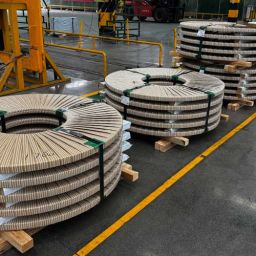
Coil packaging equipment refers to the machinery used to wrap, bind, protect, and label steel, stainless steel, aluminum, copper, and other metal coils after they have been processed. Its purpose is to:
- Protect the coil surface from scratches, abrasion, and contamination
- Prevent moisture ingress and corrosion during storage and shipment
- Maintain coil shape and prevent telescoping or loosening of wraps
- Allow safe lifting, stacking, and transportation
- Present a uniform, professional appearance and clear identification
Depending on the coil size, material, and shipping requirements, a packaging line may combine several machines into one automated system.
Main Types of Coil Packaging Equipment
1. Coil Strapping Machines
Strapping machines apply steel or PET/PP straps around the coil to hold the wraps firmly together.
- Radial (eye-to-sky) strapping passes straps through the coil’s inner diameter (ID) and around the outer diameter (OD).
- Circumferential strapping places straps around the coil’s circumference.
- Tensioning and sealing systems ensure consistent strap tension and secure joints.
Strapping is typically the first stage of coil packaging, as it stabilizes the coil before any wrapping is applied.
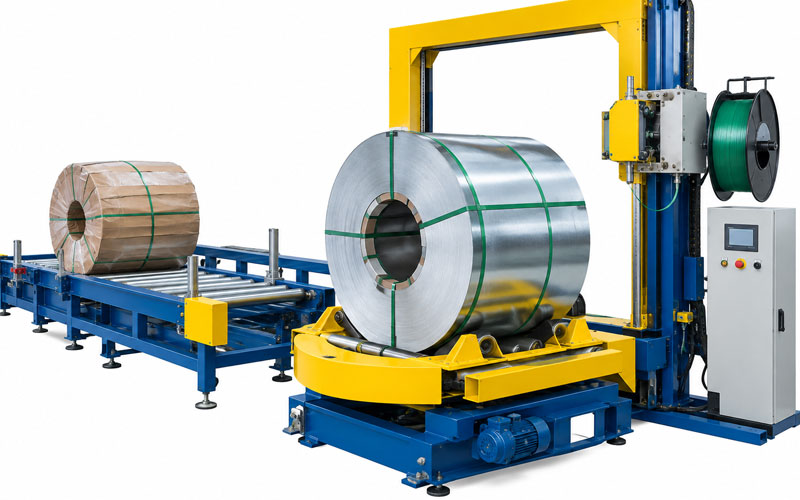
2. Coil Wrapping Machines
Wrapping machines apply protective materials to the coil, such as stretch film, VCI (Vapor Corrosion Inhibitor) paper, kraft paper, or polyethylene film.
- Orbital wrapping machines rotate the packaging material around the coil’s cross-section, passing through the eye of the coil.
- Horizontal-eye wrapping machines are used for coils with the eye in a horizontal orientation.
- Vertical-eye wrapping machines are suited to coils stored with the eye vertical.
Wrapping provides a barrier against humidity, dust, and handling damage.
3. Coil Stretch Wrapping Machines
These machines apply stretch film under controlled tension to bind and seal the coil. They are particularly suitable for narrow slit coils and small-diameter coils, where consistent film overlap is essential for protection.
4. Edge Protector and Inner/Outer Ring Systems
To protect coil edges from impact, packaging lines may include equipment that applies:
- Edge protectors (steel, cardboard, or plastic)
- Inner circumferential rings
- Outer circumferential rings
- Eye covers (inner and outer)
These components reduce the risk of edge damage during crane lifting and truck loading.
5. Coil Weighing, Labeling, and Marking Systems
Integrated weighing scales, label printers, and applicators provide traceability. Each coil can be identified with its heat number, dimensions, weight, customer name, and barcode or QR code.
6. Coil Conveying, Turning, and Tilting Equipment
Auxiliary equipment moves the coil between stations:
- Coil conveyors and walking-beam systems
- Coil tilters (turning the coil from eye-vertical to eye-horizontal)
- Coil transfer cars
- Rotary tables and stacking stations
These systems reduce manual handling and the associated safety risks.
Key Benefits of Using Coil Packaging Equipment
Consistent Packaging Quality
Automated machinery applies uniform tension, overlap, and material placement, eliminating the variability associated with manual packaging.
Improved Surface Protection
Proper wrapping with VCI paper or film significantly reduces the risk of rust, staining, and scratching, especially for cold-rolled, galvanized, stainless steel, and pre-painted coils.
Higher Productivity
A dedicated packaging line can match the output speed of the slitting or recoiling line, preventing bottlenecks at the end of the process.
Enhanced Operator Safety
Steel coils are heavy and often have sharp edges. Mechanized packaging reduces direct contact, lowering the risk of workplace injury.
Reduced Material Waste and Claims
Accurate material application avoids over-use of packaging consumables, while better protection reduces transport damage and customer claims.
Factors to Consider When Selecting Coil Packaging Equipment
Choosing the correct equipment requires careful evaluation of production and logistical requirements.
Integration with Slitting and Coil Processing Lines
Coil packaging equipment is most effective when planned as part of the complete processing line rather than as a standalone addition. In a typical steel coil slitting line, the sequence is as follows:
- Decoiler – uncoils the master coil
- Slitter head – cuts the strip into narrower widths
- Tension station and recoiler – rewinds the slit strips into finished coils
- Coil unloading car – removes finished coils from the recoiler
- Packaging line – strapping, wrapping, weighing, labeling, and discharge
When these stages are designed together, coil transfer is smooth, handling time is minimized, and the complete system operates at optimal efficiency. Manufacturers such as LotosSlitting provide engineering support to ensure that unloading, conveying, and packaging stations are properly matched to the slitting line’s capacity and coil specifications.
Common Packaging Materials Used with Coil Packaging Equipment
- VCI paper and film – offers corrosion protection through vapor-phase inhibitors
- Polyethylene (PE) film – provides moisture resistance
- Stretch film – secures and seals narrow and small coils
- Kraft paper – supplies an additional protective layer against abrasion
- Steel strapping – delivers high tensile strength for heavy coils
- PET and PP strapping – offers a lighter, safer alternative for lighter coils
- Edge protectors and ring pads – protect coil edges and eyes during handling
Maintenance Recommendations
To ensure reliable, long term operation, the following practices are recommended:
- Inspect strapping heads, cutters, and sealers regularly for wear.
- Lubricate moving parts according to the manufacturer’s schedule.
- Calibrate scales and tension-control systems periodically.
- Verify the alignment of conveyors, turntables, and tilters.
- Keep wrapping rollers and film carriages clean and free of residue.
- Train operators in proper safety and changeover procedures.
Consistent maintenance reduces unplanned downtime and extends equipment life.
Conclusion
Coil packaging equipment preserves the quality achieved during slitting, safeguards the product throughout its journey, and improves safety and productivity at the plant. For customized slitting and packaging solutions, Lotos Slitting offers professional engineering, manufacturing, and technical support. Contact our team today to discuss your requirements.
FAQ:
By applying VCI paper or film and sealing the coil with moisture-resistant wrapping, the equipment creates a protective barrier that limits exposure to humidity and contaminants.
Yes. Many systems are adjustable to accommodate a defined range of coil widths, outer diameters, and inner diameters. The operating range should be specified at the design stage.
Not always. Semi-automatic equipment may be sufficient for lower volumes, while fully automatic lines are recommended for continuous, high-output slitting operations.
Coil packaging equipment protects processed coils from damage, moisture, and corrosion while securing them for safe handling, storage, and transport.
In most cases, yes. A packaging line can be integrated after the recoiler or unloading car, provided that sufficient floor space and suitable coil transfer arrangements are available.