Steel Slitting Line Process
Steel coil processing requires high levels of dimensional accuracy, production efficiency, and material utilization. Slitting lines are specialized coil processing systems designed to convert wide master coils into narrower steel strips with controlled widths and precise edge quality.
For manufacturers processing carbon steel, stainless steel, galvanized steel, aluminum, and other coil materials, selecting the appropriate slitting line is essential for achieving consistent strip quality and reliable downstream production.
This article explains the working principle, major components, technical parameters, applications, and selection considerations of modern steel coil slitting lines.
What Is a Slitting Line?
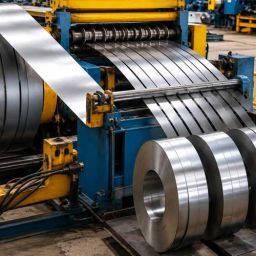
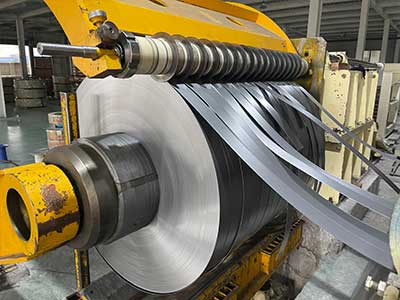
A slitting line is a coil processing machine that continuously unwinds a wide master coil, levels or tensions the strip as required, longitudinally cuts it into multiple narrower strips, and recoils the finished strips.
The basic process can be represented as:
Master Coil → Uncoiling → Leveling → Slitting → Strip Separation → Tensioning → Recoiling
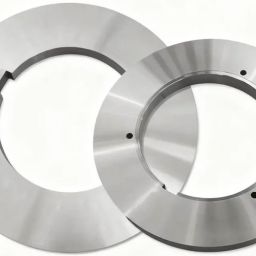
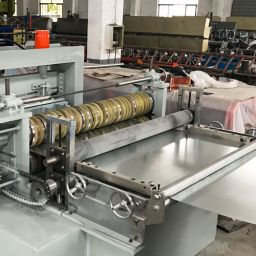
The slitting operation is performed using circular rotary knives. The knives are arranged according to the required strip widths, allowing one wide coil to be divided into several narrow coils during a continuous production process.
Modern slitting lines can be configured for different material thicknesses, coil weights, widths, and production speeds.
How Does a Slitting Line Work?
A typical slitting line operates through several coordinated stages.
1. Coil Loading
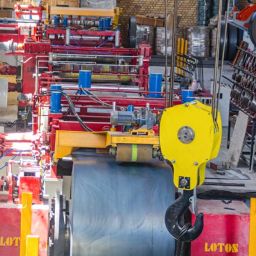
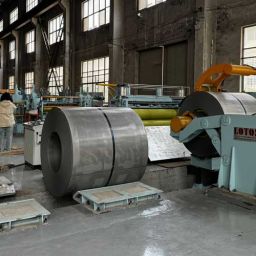
The master coil is transported to the entry section using a coil car or loading equipment.
The coil is positioned accurately on the decoiler mandrel before processing begins.
Proper coil alignment is important because incorrect positioning can cause strip deviation, uneven slitting, and poor recoiling quality.
2. Decoiling
The decoiler unwinds the master coil continuously.
Depending on the machine configuration, the decoiler may include:
- Hydraulic expansion
- Pneumatic or hydraulic braking
- Coil centering
- Coil hold-down equipment
- Automatic mandrel expansion
- Coil car loading system
The decoiler must provide stable strip tension throughout the process.
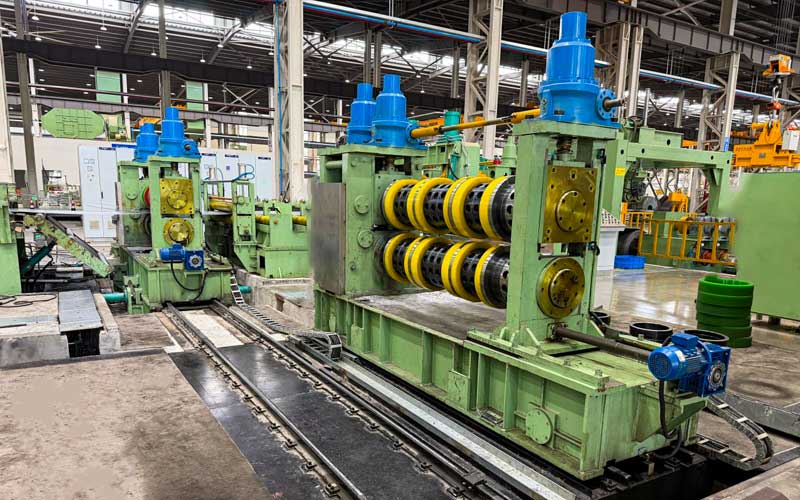
3. Leveling
Depending on the material and required product quality, a leveler can be installed before the slitting section.
The leveler reduces coil set and improves strip flatness.
For precision applications, leveling is particularly important because residual stresses and shape defects can affect the final narrow strips.
4. Slitting
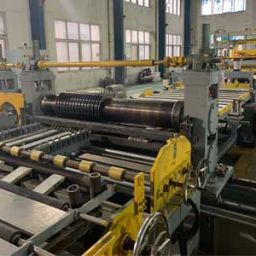
The strip enters the slitter head, which contains upper and lower circular knives.
The knives are positioned according to the required strip widths.
The cutting process divides the master strip longitudinally into multiple narrower strips.
Slitting accuracy depends on several factors, including:
- Knife diameter
- Knife material
- Knife clearance
- Knife overlap
- Strip thickness
- Material strength
- Machine rigidity
- Slitting speed
- Spacer accuracy
Correct knife setup is essential for achieving clean edges and minimizing burr formation.
5. Strip Separation
After slitting, the narrow strips must be separated and guided toward the recoiler.
Separators, spacers, and strip guides maintain the required strip arrangement.
Proper separation prevents narrow strips from overlapping or becoming misaligned during recoiling.
6. Tensioning
A tensioning unit controls the strip tension before recoiling.
Stable tension is particularly important when processing multiple narrow strips because variations in tension can result in telescoping, loose coils, or uneven coil edges.
Depending on the line design, tension control can use:
- Tension pads
- Tension rolls
- Bridle rolls
- Hydraulic systems
- Pneumatic systems
7. Recoiling
The slit strips are finally wound onto the recoiler.
The recoiler produces individual narrow coils with controlled winding tension and edge alignment.
A high-quality recoiling system should maintain consistent coil tightness and minimize telescoping.
Main Components of a Slitting Line
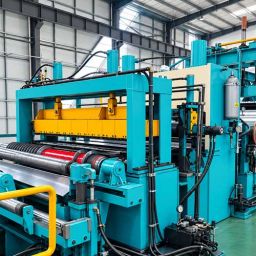
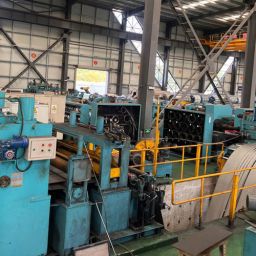
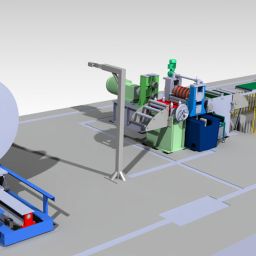
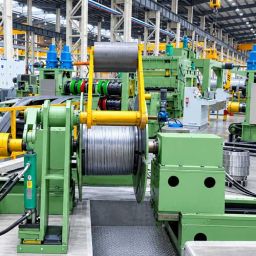
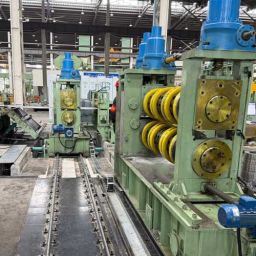
A complete steel slitting line generally consists of several integrated machines.
Typical Configuration
Entry Coil Car → Decoiler → Leveler → Slitter Head → Separator → Tension Unit → Recoiler → Exit Coil Car
Depending on the application, additional equipment may include:
- Scrap winder
- Side trimmer
- Pinch rolls
- Entry guide
- Looping pit
- Edge guide system
- Automatic knife positioning
- Hydraulic system
- Electrical control system
- PLC control
- HMI touch screen
- Coil unloading system
The exact configuration should be selected according to the material and production requirements.
Slitter Head and Rotary Knives
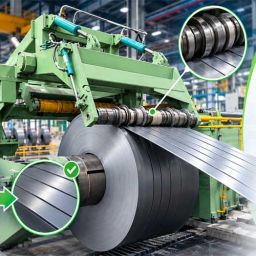
The slitter head is the core cutting section of a slitting line.
It normally consists of upper and lower knife shafts equipped with circular rotary knives and precision spacers.
The knives must be correctly positioned to achieve the required strip width.
Important Slitting Parameters
Several parameters directly influence cutting performance:
- Knife clearance
- Knife overlap
- Knife sharpness
- Spacer thickness
- Shaft runout
- Material thickness
- Material tensile strength
- Slitting speed
Incorrect knife clearance can produce excessive burrs, poor edge quality, or accelerated knife wear.
Therefore, knife setup is one of the most important technical procedures in coil slitting.
Knife Clearance in Coil Slitting
Knife clearance refers to the horizontal and vertical relationship between the upper and lower circular knives.
The appropriate clearance depends on the material properties and thickness.
For example, stainless steel, carbon steel, and high-strength steel may require different knife-setting parameters.
If the clearance is too large, the material may deform excessively before being cut. If the clearance is too small, cutting forces and tool wear can increase.
Therefore, the slitting knives should be adjusted according to:
Material Type + Material Thickness + Tensile Strength + Required Edge Quality
What Materials Can Be Processed?
Slitting lines can be designed for various metallic materials, including:
Carbon Steel
Carbon steel slitting lines are widely used for general industrial applications, structural products, and downstream forming operations.
Stainless Steel
Stainless steel requires precise knife selection and machine settings because of its higher strength and work-hardening characteristics.
Precision slitting is particularly important when narrow stainless steel strips are supplied to tube mills, roll forming machines, stamping lines, and other processes.
Galvanized Steel
Galvanized coils can be slit into narrow strips for construction, HVAC, automotive, and manufacturing applications.
The slitting system should minimize surface damage and maintain consistent edge quality.
Aluminum
Aluminum requires appropriate knife geometry and tension control because of its lower hardness and different material characteristics.
Slitting Line Speed
Production speed is one of the key specifications when selecting a slitting machine.
The maximum operating speed depends on:
- Material thickness
- Material width
- Material strength
- Coil weight
- Slitting width
- Knife configuration
- Machine design
- Recoiling requirements
A high speed slitting line is not necessarily the best solution for every application. Stable operation, cutting accuracy, tension control, and finished coil quality must also be considered.
For example, a precision stainless steel slitting application may prioritize edge quality and dimensional accuracy over maximum line speed.
Automatic Knife Positioning
Modern slitting lines can incorporate automatic knife positioning systems.
Instead of manually calculating and positioning each knife and spacer, an automated system can determine the required knife arrangement according to the production order.
Advantages include:
- Reduced setup time
- Improved positioning accuracy
- Lower operator workload
- Faster product changeover
- Reduced setup errors
- Better production repeatability
Automatic positioning is particularly valuable for high-mix production environments.
Scrap Management
Slitting operations normally generate edge trim or scrap.
A scrap winder collects the edge scrap continuously during production.
Effective scrap management prevents material accumulation around the slitting section and improves overall line safety and productivity.
The scrap system should be appropriately sized according to:
- Strip thickness
- Scrap width
- Material strength
- Production speed
- Coil length
Tension Control and Coil Quality
Tension control has a major influence on the quality of finished slit coils.
Insufficient tension may result in:
- Loose coils
- Coil instability
- Telescoping
- Poor strip alignment
Excessive tension may cause:
- Strip deformation
- Surface damage
- Edge distortion
- Recoiling problems
A properly designed tension control system maintains stable winding conditions throughout the production cycle.
Advantages of Modern Slitting Lines
A properly configured slitting line provides several important production benefits.
High Dimensional Accuracy
Precision knife positioning and rigid machine construction help maintain consistent strip widths.
Improved Edge Quality
Correct knife clearance and overlap reduce burrs and edge deformation.
High Productivity
Continuous processing allows manufacturers to slit large master coils efficiently.
Flexible Production
One master coil can be divided into different strip widths according to customer requirements.
Reduced Material Waste
Accurate slitting patterns can improve material utilization and reduce unnecessary scrap.
Integration With Downstream Processes
Slit coils can be directly supplied to:
- Tube mills
- Roll forming machines
- Stamping machines
- Press lines
- Welding lines
- Sheet processing systems
Slitting Line Applications
Steel slitting lines are widely used in industries such as:
- Automotive manufacturing
- Steel service centers
- Tube and pipe manufacturing
- Construction
- HVAC
- Electrical equipment
- Appliance manufacturing
- Metal fabrication
- Solar structure manufacturing
- General industrial production
Slit strips can serve as raw material for many downstream forming and fabrication processes.
How to Choose a Slitting Line
Selecting a slitting line should begin with the required production parameters.
1. Define the Material
Specify whether the line will process:
- Carbon steel
- Stainless steel
- Galvanized steel
- Aluminum
- High-strength steel
2. Define Thickness
The maximum and minimum material thickness determine the required machine structure, knife system, and drive capacity.
3. Define Coil Width
The maximum master coil width determines the working width of the slitting line.
4. Define Coil Weight
Heavy coils require an appropriately designed decoiler, coil car, slitter, and recoiler.
5. Define Finished Strip Width
The required minimum strip width and number of strips determine the knife and spacer configuration.
6. Define Production Speed
The required production volume should be considered together with material thickness and finished-coil quality.
7. Consider Automation
For high-volume production, automatic knife positioning, PLC control, automatic tension control, and automated coil handling can significantly improve productivity.
Quality Control in Steel Coil Slitting
Quality control should be applied throughout the entire slitting process.
Important inspection points include:
- Strip width
- Edge burr
- Strip flatness
- Coil alignment
- Coil tightness
- Surface condition
- Strip tension
- Coil weight
- Knife condition
For precision applications, dimensional inspection equipment can be integrated into the production process.
Conclusion
Slitting lines are essential coil processing systems for manufacturers that require wide steel coils to be converted into narrower strips with controlled dimensions and consistent quality.
A modern slitting line integrates decoiling, leveling, precision rotary slitting, strip separation, tension control, and recoiling into one continuous production system. The selection of knife configuration, machine capacity, tension system, automation level, and coil-handling equipment should be based on the material and final product requirements.
For manufacturers processing carbon steel, stainless steel, galvanized steel, or other coil materials, a properly engineered slitting line can improve production efficiency, dimensional accuracy, edge quality, and material utilization.