A Technical Guide for Metal Processors
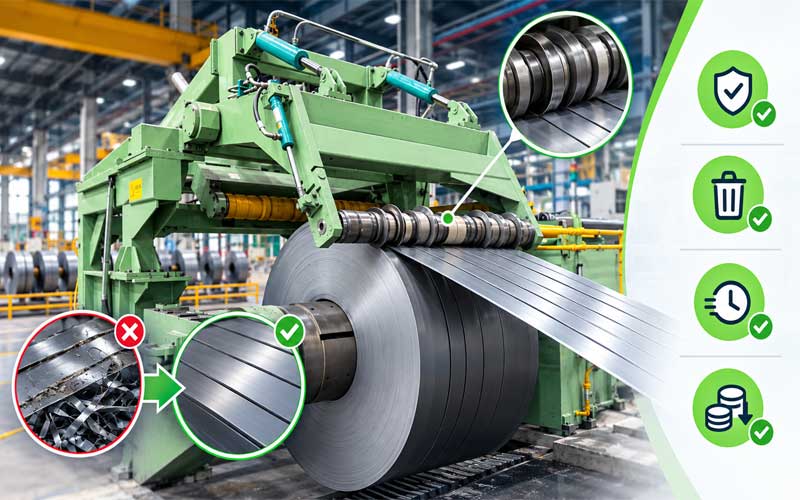
Scrap generation is one of the most persistent challenges in coil slitting operations. Even small inefficiencies in blade setup, tension control, or line calibration can compound across thousands of feet of processed material, resulting in significant material loss, reduced yield, and higher production costs. For metal service centers and coil processors, minimizing scrap is not just a matter of efficiency ; it directly affects profitability, customer satisfaction, and equipment longevity.
This article examines the primary causes of scrap in coil slitting and outlines proven, technically grounded strategies to reduce it.
Understanding Scrap in Coil Slitting
In coil slitting, scrap typically falls into several categories:
- Edge trim waste — material removed from the outer edges of the coil to eliminate camber, edge damage, or mill-edge irregularities.
- Burr and edge-quality scrap — strips rejected or reworked due to excessive burr height, poor edge finish, or dimensional inconsistency.
- Camber and bow-related scrap — strips that deviate from straightness tolerances due to uneven slitting forces.
- Start-up and threading scrap — material lost during line setup, threading, and initial tension stabilization.
- Coil breaks and telescoping — scrap resulting from improper rewinding, causing damaged or unusable wraps.
Identifying which category dominates a given operation is the first step toward targeted scrap reduction.
1. Optimize Knife (Blade) Clearance and Overlap
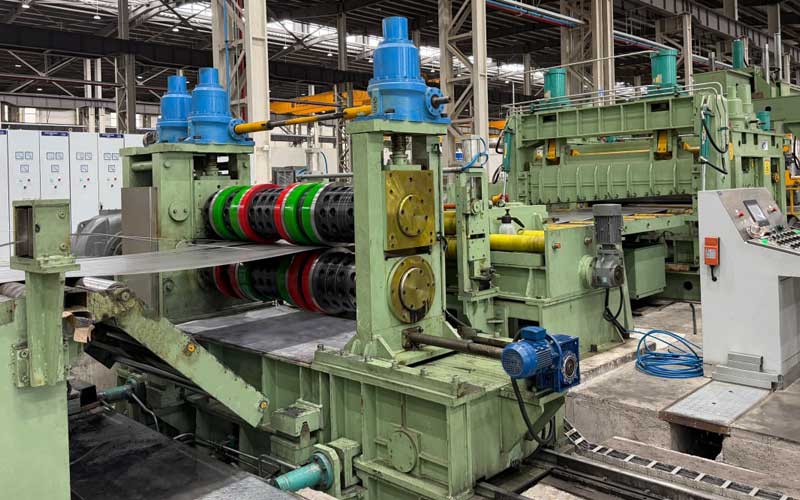
Improper knife clearance is one of the leading causes of poor edge quality and excessive burr formation. If the clearance between the upper and lower knives is too large, the material tears rather than shears cleanly, producing rough edges and increasing the likelihood of downstream rejection.
Best practices:
- Set knife clearance according to material thickness and hardness — typically 5–10% of material thickness as a starting reference, adjusted based on alloy and temper.
- Maintain proper knife overlap (horizontal penetration), generally between 0.006″ and 0.015″ depending on gauge.
- Recalibrate clearance whenever switching between material grades or thicknesses.
Precise clearance settings reduce burr height, which in turn reduces the volume of edge-quality scrap and rework.
2. Maintain Sharp, Properly Spaced Tooling
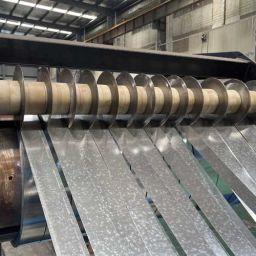
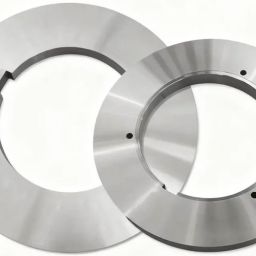
Dull or chipped slitting knives accelerate burr growth and increase the risk of edge cracking, particularly in higher-strength steels and coated materials. A structured tooling maintenance program should include:
- Scheduled knife regrinding based on tonnage processed, not just visual inspection.
- Accurate spacer and shim selection to maintain consistent strip width tolerances.
- Regular inspection of arbor spacers for wear, which can cause width drift over long runs.
Many processors find that a documented regrinding interval — rather than a reactive “replace when it fails” approach — meaningfully reduces both scrap and unplanned downtime.
3. Control Coil Tension Throughout the Line
Inconsistent tension across the uncoiler, slitter head, and recoiler is a major contributor to camber, telescoping, and coil breaks. Tension that is too loose allows strip wander and edge damage; tension that is too tight increases the risk of stretching, especially in thinner or softer gauges.
Key considerations:
- Match tension settings to material yield strength and gauge.
- Use closed-loop tension control systems where possible, rather than manual dancer-roll adjustment alone.
- Verify tension consistency at start-up, mid-coil, and tail-end, since tension requirements can shift as coil diameter changes.
Stable tension throughout the run reduces both camber-related scrap and the risk of coil damage during rewinding.
4. Minimize Start-Up and Threading Losses
Every threading cycle consumes material before the line reaches stable running conditions. While some start-up loss is unavoidable, it can be minimized through:
- Standardized threading procedures that reduce operator variability.
- Pre-set line parameters (tension, clearance, guide positions) stored by material specification, reducing trial-and-error adjustment during setup.
- Efficient coordination between uncoiling, slitting, and recoiling sections to shorten the stabilization period.
Reducing setup time not only lowers scrap but also improves overall line throughput.
5. Inspect Incoming Coil Quality
Scrap reduction begins before the coil even reaches the slitter. Mill-edge defects, existing camber, coil set, or surface damage in the incoming material will propagate through the slitting process regardless of how well the line is calibrated.
Recommended practices:
- Establish incoming inspection criteria for edge condition, camber, and surface quality.
- Communicate tolerance requirements clearly with coil suppliers.
- Segregate marginal-quality coils for lower-tolerance applications rather than processing them into precision-width orders.
6. Implement Real-Time Monitoring and Statistical Process Control
Modern slitting lines increasingly incorporate sensors for width measurement, tension monitoring, and edge inspection. Applying statistical process control (SPC) to this data allows operators to detect drift in width, burr height, or camber before it results in out-of-tolerance scrap.
Benefits of real-time monitoring include:
- Early detection of knife wear trends.
- Faster identification of tension instability.
- Data-driven maintenance scheduling rather than fixed-interval servicing.
7. Train and Standardize Operator Practices
Even with well maintained equipment, operator technique significantly influences scrap rates. Variability in threading speed, tension adjustment, and knife-setting procedures between shifts or operators often accounts for inconsistent scrap performance across an otherwise identical line.
Standardized work instructions, combined with periodic operator training and cross-verification of setup parameters, help ensure consistent results regardless of who is running the line.
Conclusion
Reducing scrap in coil slitting requires a systematic approach that addresses tooling precision, tension control, incoming material quality, and process standardization together rather than treating scrap as an unavoidable cost of production. Processors that invest in proper knife clearance management, tension control systems, and operator standardization typically see measurable improvements in yield, edge quality, and overall line efficiency.
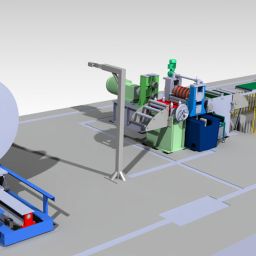
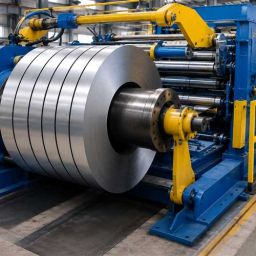
At Lotosslitting, precision-engineered slitting lines are designed with these principles in mind, combining accurate tooling systems, reliable tension control, and consistent line calibration to help processors minimize scrap and maximize material yield.
FAQ:
Regrinding intervals should be based on tonnage processed and material type rather than a fixed calendar schedule. Establishing a documented interval, supported by periodic edge-quality inspection, helps prevent burr-related scrap before it becomes noticeable.
Significantly. Mill-edge defects, existing camber, and surface damage in the incoming coil will carry through the slitting process regardless of line calibration. Establishing incoming inspection criteria helps prevent unnecessary downstream scrap.
Sensors that track width, tension, and edge quality allow operators to detect drift — such as gradual knife wear or tension instability — before it results in out-of-tolerance material, enabling proactive rather than reactive maintenance.
The most common causes are improper knife clearance and overlap, dull or worn tooling, inconsistent coil tension, and poor incoming coil quality. These factors lead to burr formation, camber, and off-tolerance strips that must be scrapped or reworked.