What is Precision Slitting?
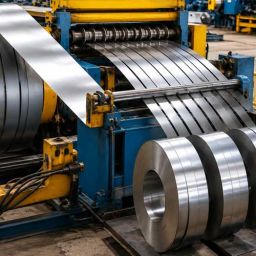
Slitting is the process of cutting a wide master coil into multiple narrower strips of defined width. As downstream industries demand tighter tolerances, cleaner edges, and more consistent coil geometry, high precision slitting has become a decisive capability for steel service centers and manufacturers.
High precision slitting delivers strips with minimal width deviation, low burr, controlled camber, and neat coil winding. These qualities directly affect the performance of stamping, roll forming, welding, lamination, and other subsequent operations.
What Is High Precision Slitting?
High precision slitting refers to a slitting process, supported by appropriately engineered equipment, that consistently achieves strict dimensional and quality requirements across the whole production run. It is characterized by:
- Narrow and repeatable strip width tolerance
- Low and uniform burr height
- Minimal camber (edge curvature) and bow
- Clean, smooth cut edges without cracks or edge rollover
- Even, tight, and well-aligned recoiled coils without telescoping
- Preserved surface quality, with no scratches or marks
Precision is not the result of a single component. It emerges from the interaction of machine rigidity, tooling quality, tension control, material condition, and operating discipline.
Key Technical Factors That Determine Slitting Precision
1. Slitter Head and Arbor Accuracy
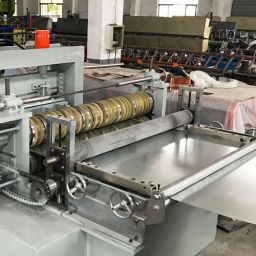
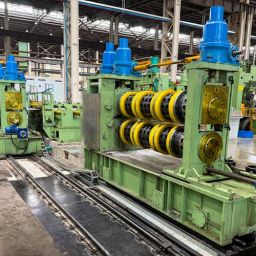
The slitter head carries the upper and lower arbors on which the circular knives are mounted. Its accuracy is fundamental to precision:
- Arbor run out must be minimal, since any eccentricity changes the knife overlap and produces uneven edges.
- Rigid construction limits deflection under cutting force.
- Accurate knife positioning ensures that strip widths remain consistent from edge to edge.
- Precise overlap and clearance adjustment allows the cut to be matched to the material thickness and grade.
High precision lines often use hardened and ground arbors, high quality bearings, and motorized or CNC assisted knife positioning to achieve repeatable setups.
2. Knife Quality and Condition
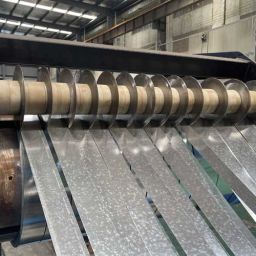
Circular slitter knives and spacers determine the quality of the cut edge.
- Tool steel or carbide knives with suitable hardness provide long life and sharp edges.
- Knife and spacer thickness tolerance must be extremely tight, because the total stack height defines the strip width.
- Regular regrinding and inspection preserves cutting geometry.
- Knife material and coating should be selected according to the processed material, whether carbon steel, stainless steel, aluminum, or coated strip.
3. Knife Clearance and Overlap
Correct clearance and overlap are essential for clean shearing.
- Excessive clearance causes high burrs, edge rollover, and a rough fracture zone.
- Insufficient clearance increases cutting force, accelerates knife wear, and may damage the strip edge.
- Settings should be adjusted according to material thickness, tensile strength, and hardness.
4. Entry Guiding and Centering
Accurate strip guiding ensures that the material enters the slitter in a stable, centered position.
- Precision entry guides and side guide rollers control lateral movement.
- Stable guiding reduces camber and prevents width variation.
- A properly aligned decoiler, pinch roll, and slitter are essential for straight tracking.
5. Tension Control
Consistent tension through the line protects strip quality and recoil accuracy.
- Decoiler braking or back tension keeps the strip taut and stable at entry.
- Looping pit or loop control isolates the slitter from the decoiler and recoiler speed variations.
- Separator and tension unit maintain uniform tension across all strips before recoiling.
- Recoiler tension control, often using a servo or torque motor, produces tight and even coils.
Poor tension control is a leading cause of telescoping, loose coils, and surface damage.
6. Separator and Recoiler Design
After slitting, individual strips must be separated and wound without interference.
- A separator with adjustable discs or plates prevents strips from rubbing or overlapping.
- A recoiler with a rigid mandrel, precise side alignment, and an accurate drive ensures neat coil edges.
- A tension station with pad or roller tension equalizes strip tension across all widths.
7. Line Speed Stability and Drive System
A stable drive system with smooth acceleration and deceleration prevents tension fluctuations and cutting irregularities. Modern lines use frequency-controlled or servo drives with PLC coordination to maintain synchronization between all units.
8. Control System and Measurement
Advanced control systems add repeatability and traceability:
- PLC and HMI for recipe storage, knife setup data, and line parameters
- Encoders for accurate length and speed measurement
- Edge position control for strip centering
- Optional inline measurement of width and thickness
- Automatic knife positioning to shorten setup time and reduce human error
9. Incoming Coil Quality
Even the best slitting line cannot fully compensate for poor coil quality. Thickness variation, edge camber, coil set, and flatness defects influence slitting results. Incoming inspection and, where required, leveling or edge conditioning improve outcomes.
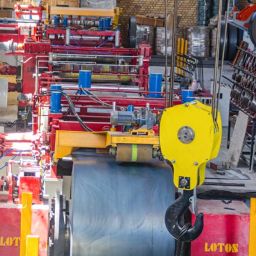
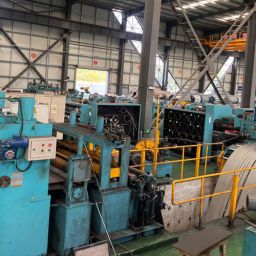
Components of a High Precision Slitting Line
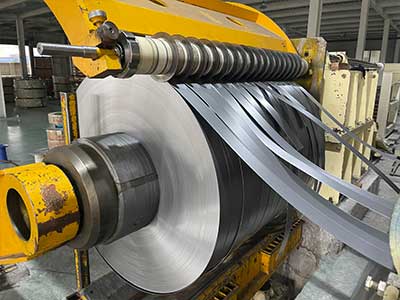
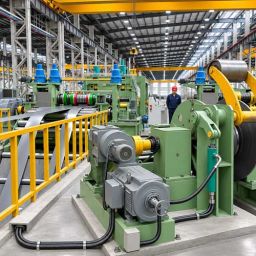
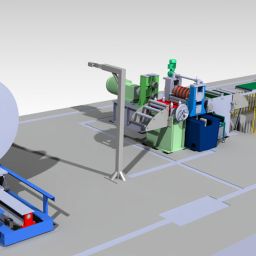
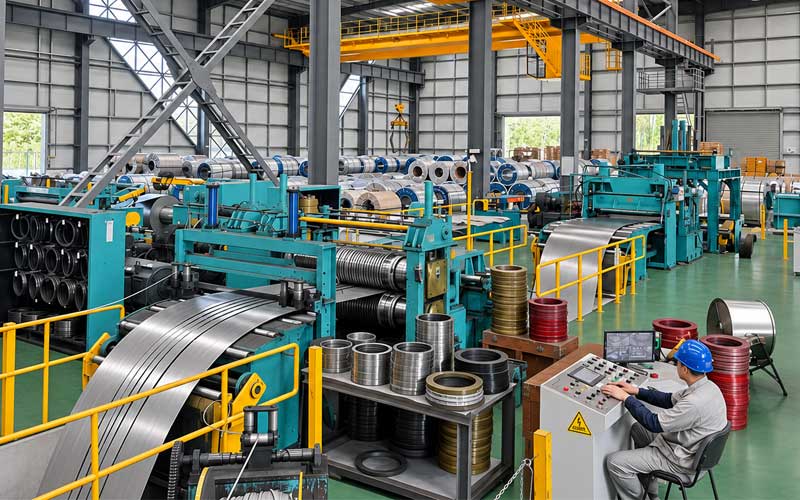
A complete precision slitting line typically includes:
- Coil car: Safe, accurate coil loading
- Decoiler: Controlled payoff with back tension
- Pinch roll and leveler (optional): Flattening and feeding of the strip
- Entry guide: Centering and tracking control
- Slitter head: Precision knife arbors and positioning system
- Scrap winder or chopper: Handling of edge trim
- Loop pit: Tension isolation between sections
- Separator and tension unit: Strip separation and tension equalization
- Recoiler: Winding of slit strips into neat coils
- Coil unloading and strapping equipment (optional): Coil discharge and packaging
- PLC control system: Coordination and monitoring of the entire line
Benefits of High Precision Slitting
- Improved downstream performance: Accurate strip width and clean edges support stable stamping, forming, and welding.
- Reduced scrap and rework: Consistent dimensions lower rejection rates.
- Higher material yield: Optimized cutting plans and precise widths reduce trim waste.
- Enhanced customer satisfaction: Reliable quality builds long-term supply relationships.
- Access to demanding markets: Precision capability allows suppliers to serve automotive, electrical, and electronics industries.
- Lower tooling wear in subsequent processes: Low burr strip reduces damage to dies and rolls.
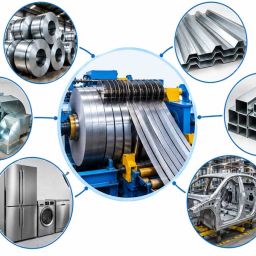
Applications
High precision slitting is widely used for:
- Electrical steel: Transformer and motor laminations
- Automotive components: Brackets, structural parts, and body components
- Stainless steel: Decorative, kitchen, and industrial applications
- Aluminum and non-ferrous strip: Packaging, heat exchangers, and building materials
- Pre-painted and galvanized steel: Roll forming, roofing, and appliance panels
- Tube and pipe manufacturing: Strip for welded tube mills
- Electronics and precision components: Thin gauge strip with strict tolerances
Factors to Consider When Selecting a Precision Slitting Line
Material Range
Define the thickness, width, coil weight, and material grades to be processed. Thin and high strength materials require different knife and tension configurations.
Required Tolerances
Specify the required width tolerance, burr limit, and camber. These requirements determine the necessary level of machine rigidity and control sophistication.
Production Volume and Changeover Frequency
High mix production benefits from automatic knife positioning and quick change tooling. High volume, low mix operations may prioritize speed and automation.
Tooling Strategy
Consider the availability, regrinding capacity, and cost of knives and spacers. A precise knife and spacer management system is essential for long term accuracy.
Tension and Recoiling Requirements
Select a tension system suited to the material thickness and surface sensitivity, particularly for thin, polished, or coated strip.
Manufacturer Experience and Support
Choose a supplier with proven experience in slitting equipment, clear technical documentation, installation support, and responsive after sales service.
Best Practices for Maintaining Slitting Precision
- Inspect knives regularly and regrind or replace them before the edge quality deteriorates.
- Measure knife and spacer thickness and keep stacks within tolerance.
- Verify arbor run out and bearing condition on a scheduled basis.
- Check alignment of the decoiler, entry guide, slitter, and recoiler.
- Calibrate encoders and measuring systems periodically.
- Keep the line clean, as metal particles can damage the strip surface.
- Document verified setup parameters for each material and thickness.
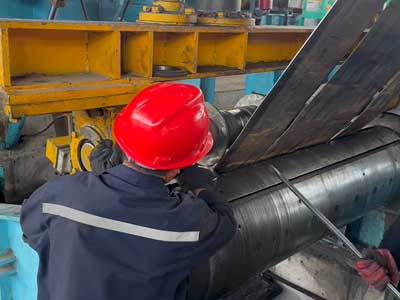
- Train operators in setup procedures and quality inspection.
Conclusion
High precision slitting depends on the combined performance of a rigid slitter head, accurately manufactured knives, stable tension control, reliable guiding, and a coordinated control system. When these elements are properly designed, maintained, and operated, producers achieve narrow tolerances, clean edges, and consistent coil quality that meet the requirements of demanding industries.
LotosSlitting designs and manufactures slitting lines with attention to structural rigidity, tooling accuracy, and control stability, supporting consistent precision across a wide range of materials and thicknesses. For technical consultation or a customized slitting line solution, please contact the LotosSlitting team.
FAQ :
Well-designed lines typically achieve a width tolerance of approximately ±0.05 mm to ±0.10 mm, depending on the material and strip width.
Correct clearance produces a clean cut, while incorrect clearance causes high burrs, edge rollover, and faster knife wear.
Stable tension keeps the strip straight and prevents telescoping, loose coils, and surface damage during recoiling.
Electrical steel, automotive, stainless steel, aluminum, tube manufacturing, and electronics industries require precision slit strip.
Yes, LotosSlitting customizes the line according to your material, thickness, width, tolerance, and production requirements.